
The Five Animal Frolics (Wu Qin Xi)
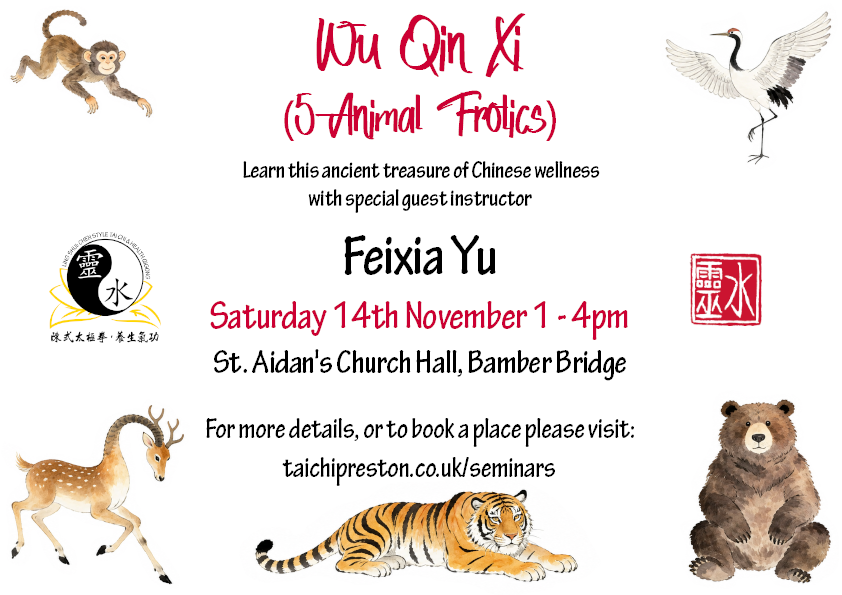
On Saturday 14th November we'll be joined by our friend Feixia Yu for an afternoon looking at the ancient Qigong practice of The Five Animal Frolics (Wu Qin Xi) which is one of the oldest systems of Health Qigong, traditionally attributed to Hua Tuo, a physician who lived during the Eastern Han Dynasty around 2,000 years ago. Unlike some of the more familiar Qigong sets which focus on specific movements and their effects on the body, Wu Qin Xi takes its inspiration from the natural movements and characteristics of the five animals: Tiger, Deer, Bear, Monkey and Crane.
The idea isn't simply to imitate the movements of these animals, but to embody something of their individual qualities. Each animal represents a different way of moving, with its own character and emphasis, making the complete sequence a varied and interesting practice.
Although the set has evolved over the centuries, its traditional origins are well documented in early Chinese texts. The version we'll be practising at the seminar is the one most commonly taught in China today, standardised by the Chinese Health Qigong Association in 2003 and drawing upon traditional forms to create a sequence suitable for wider public practice.
The Five Animals
Each animal brings something different to the practice, both in terms of physical movement and the qualities we're trying to develop.
The Tiger
The Tiger represents strength, power and focused intent. Its movements include deep crouching postures, powerful extensions of the arms and claw-like hand movements. The emphasis is on developing rooted strength and the ability to express power without unnecessary tension. In Traditional Chinese Medicine, the Tiger is associated with the liver and tendons.
The Deer
In contrast to the Tiger, the Deer embodies grace, lightness and awareness. Its movements are more fluid, incorporating gentle rotations of the waist and spine, lateral stretches and antler-like gestures with the hands. The emphasis is on maintaining a light, alert quality whilst moving freely. Traditionally, the Deer is associated with the kidneys and bones.
The Bear
The Bear is all about stability, groundedness and the deliberate movement of weight. Its movements tend to be slower and heavier, with low stances and a rolling, swaying action through the torso. Although the movements may appear relatively simple, they require an awareness of posture, balance and the way the body settles into each position. The Bear is associated with the spleen and stomach in Traditional Chinese Medicine.
The Monkey
If the Bear is slow and deliberate, the Monkey is almost its opposite. Quick, lively and playful, its movements involve quick changes of direction, reaching and grabbing actions, and light footwork. It requires coordination and alertness rather than simply settling into a steady rhythm as is the case with the preceding animals. The Monkey is traditionally associated with the heart.
The Crane
The Crane brings the sequence to a graceful and expansive close. Its movements include spreading the arms like wings, opening the chest and balancing on one leg. There's an emphasis on lightness, balance and the coordination of movement with breathing. The Crane is associated with the lungs, and its open, elevated movements provide a natural way to finish the sequence.
It's worth noting that the association of the movements with the organs of the body comes from Traditional Chinese Medicine (TCM) theory rather than reflecting the more functional understanding of modern Western medicine. TCM aside, the sequence of physical movements offer an opportunity to work on flexibility, coordination, balance and bodily awareness.
You can watch the YouTube video below to see Master Faye Yip demonstrate the Chinese Health Qigong version of the exercises.
To book a place at the seminar, head over to our website, here.
