Happy (Lunar) New Year!
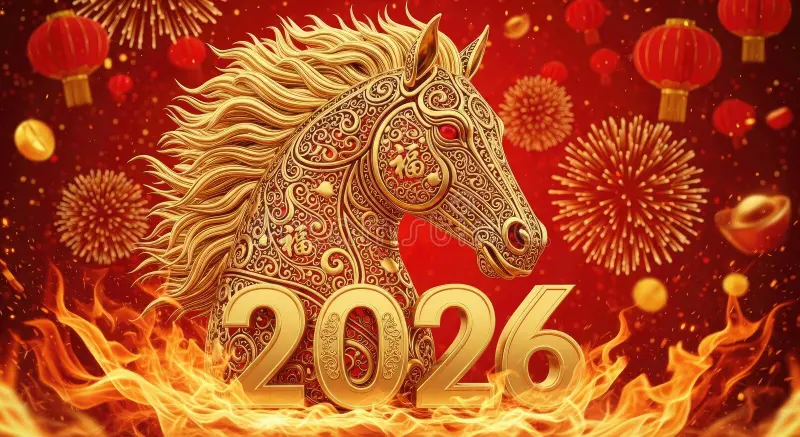
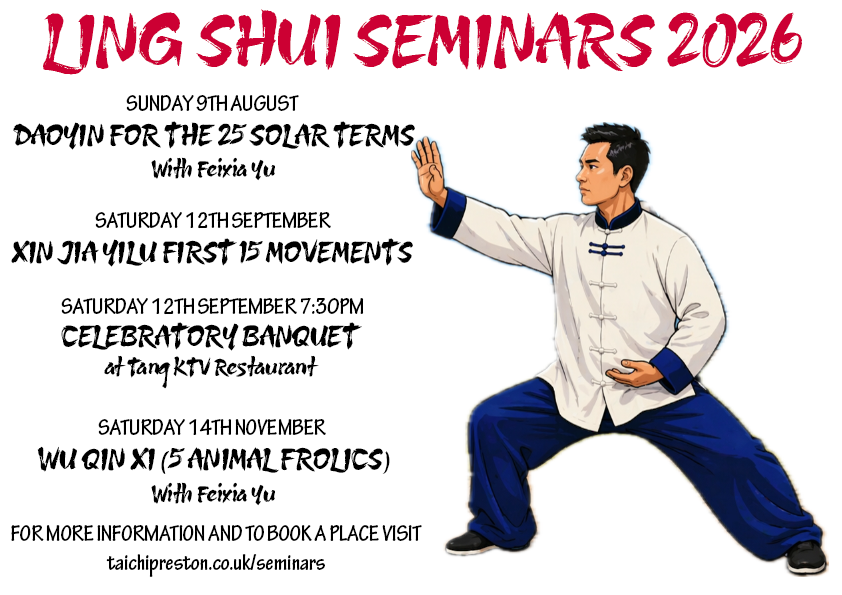
2026 is the year of the Horse. We usually celebrate the New Year with a day of Tai Chi and Qigong practice followed by an evening out at our favourite Chinese restaurant, Tang KTV. Unfortunately, due to circumstances beyond our control, we're unable to hold our usual events and will be rescheduling them for later in the year. As we aren't celebrating physically, I thought it might be a nice idea to talk a little about how we can view the horse in terms of our Tai Chi.
The Chinese Year of the Horse reflects a symbolism that resonates deeply with both ancient philosophy and internal arts such as Tai Chi. Within the Chinese zodiac, each year is represented by an animal and the horse holds the seventh position in this repeating cycle. It's traditionally associated with strength, vitality, courage, loyalty, and freedom, all of which are qualities venerated in Chinese culture.
We can think of horse as representing movement and forward momentum. It doesn't hesitate, but rather commits fully. There's an old Chinese expression: "ma dao cheng gong", which translates roughly as “success arrives with the horse”, reflecting the idea of swift progress and decisive action. The idea of purposeful motion could be considered analogous to our Tai Chi practice. Although Tai Chi largely appears slow and gentle on the surface, beneath that calm exterior lies intent, direction, and continuity. Like the horse, our movement whilst practising Tai Chi never truly stops. Even in stillness, there is potential energy waiting to be released.
The horse can also be considered in terms of Yin - Yang theory. Yin and Yang describe the opposite and yet complementary forces which underpin all existence. Yin represents stillness, receptivity, and grounding, whilst Yang represents activity, expansion, and expression. The horse is unmistakably a Yang symbol embodying activity, warmth, and dynamic expression. Yet, like all Yang forces, it cannot exist without Yin. A horse at full gallop relies upon a momentary pause between each stride. Motion arises from stillness, and stillness prepares the way for motion.
This principle is at the very heart of Tai Chi. Every step emerges from rootedness. Every extension is supported by relaxation. Yin Yang theory tells us that movement and stillness are not opposites, but rather phases of the same cycle. The horse expresses this perfectly. It is powerful, but also sensitive. Responsive, yet grounded. Without balance, its strength would become instability.
In our Tai Chi practice we make direct references to the horse: The Horse Stance develops strength, stability, endurance, and structural integrity. It teaches patience and rooting, providing the foundation from which fluid movement can emerge. Without a stable base, motion loses its integrity. The horse teaches us that true freedom of movement comes from disciplined structure.
In Chen Tai Chi, the movement Part the Wild Horse’s Mane expresses calm control combined with a forward intention. The imagery is of gently separating a horse’s mane, not through force, but through sensitivity and guidance. One hand rises as the other settles, embodying the balance of Yin and Yang. Expansion and rooting occurring simultaneously. The body advances with quiet confidence, driven from the centre and expressed through relaxed, spiralling limbs. This movement teaches us that true power does not come from tension, but from coordinated, whole-body connection. Like approaching a spirited horse, it requires presence, steadiness, and respect. The practitioner learns to move forward without aggression, maintaining balance, structure, and inner calm. In this way, the movement reflects the deeper Tai Chi principle of strength guided by softness and motion governed by awareness.
In the spirit of the Horse, take a moment to reflect upon momentum in your own life. Set aside frantic activity in favour of purposeful direction. Even when the path is uncertain, continue to move forwards with courage and resilience. At the same time, Yin and Yang remind us that all progress should be balanced with stillness. Effort balanced with ease.
So you see, the horse is much more than just a symbol of speed. It's a reminder of harmony in motion. Strength guided by balance. Energy guided by awareness. And this, ultimately, is the essence of Tai Chi itself.