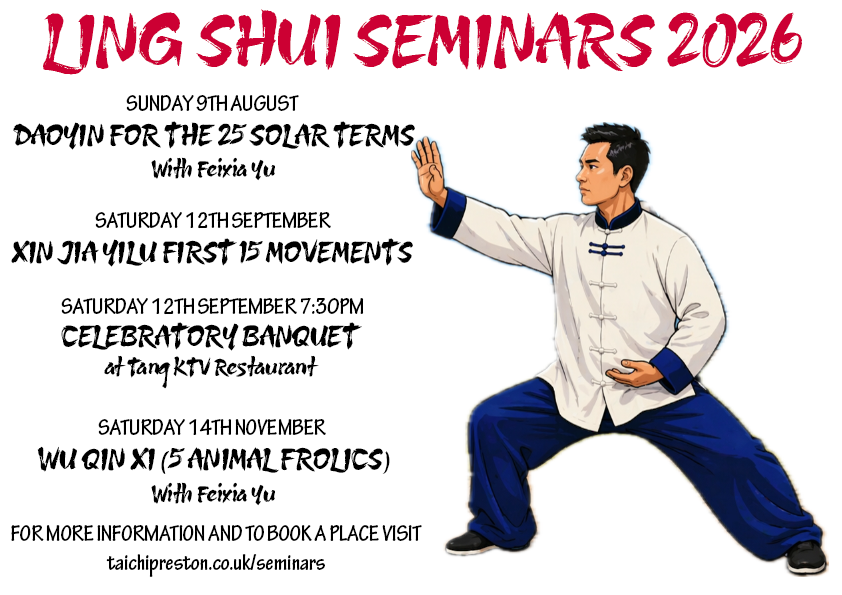
After a slow start to the year and to make up for missing the lunar new year, we've got a few seminars booked (with hopefully one or two more to follow before the end of the year).
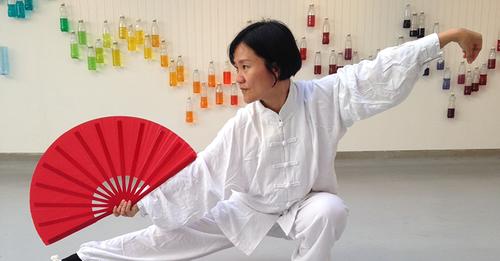
We've got Feixia Yu joining us in August and again in November, first for a TCM focussed dive into Daoyin for the 25 Solar Terms, followed by a refresher session looking at the Wu Qin Xi (5 Animal Frolics) sequence of exercises. Feixia's seminars are always popular so make sure you sign up as soon as possible to avoid disappointment.
In September we'll be running an afternoon workshop looking at the first 15 movements of Xin Jia Yilu. It's a great opportunity for those familiar with the form to brush up their knowledge and the perfect introduction to the new frame for those only familiar with the old frame and Lao Jia Yilu. In the evening we'll be heading to Tang KTV Restaurant on Fylde Road in Preston for a club banquet. Tang is Preston's premier Chinese restaurant and our social gatherings there are always well attended. There's always a great selection of dishes shared on the table (including vegetarian), so whatever your tastes there'll be plenty of things to choose from. Club members past and present are welcome at the banquet (as are their plus ones) and attendance at the seminar earlier in the day isn't necessary.
For more information about the seminars, the workshop or the meal head over to the website where you can also book a place on your preferred event.
All our seminars are open to all none club members. The Qigong events require no previous experience or knowledge, however our Tai Chi seminars are not suitable for complete beginners. If you're unsure about whether to sign up, get in touch via our contact form.
Living with Ehlers-Danlos Syndrome (EDS) can be incredibly challenging, with symptoms like chronic pain, fatigue, and limited mobility often impacting daily life. For some, Qigong (a gentle, ancient Chinese practice combining slow movements, meditation, and breathing) has offered a surprising and effective way to manage symptoms.
Originally developed over 5,000 years ago, Qigong is rooted in Chinese medicine and martial arts. Unlike more strenuous forms of exercise, Qigong is accessible for those with physical limitations. Its flowing, low-impact movements can be done standing, sitting, or even in short sessions, making it adaptable for people with conditions like EDS.
The benefits of Qigong for EDS sufferers are profound. Its gentle movements help build strength and improve flexibility without straining the body, while the focus on breathwork and mindfulness promotes relaxation and reduces stress (a key factor in managing chronic pain). Many who practise Qigong report feeling energised, more mobile, and less reliant on medication.
If you’re curious about how Qigong can help alleviate EDS symptoms, this BBC article shares an inspiring story of recovery and resilience. It’s a fascinating glimpse into how this ancient practice is making a modern impact on lives.
The Liu Zi Jue, also known as the Six Healing Sounds, holds a special place in Traditional Chinese Medicine (TCM) offering a unique approach to health and well-being. We're delighted to announce that Feixia Yu from the UCLan Confucius Institute will be joining us this October for an afternoon learning and practicing this ancient health Qigong exercise.
Click to reserve a place at our Autumn Liu Zi Jue seminar
Liu Zi Jue, which translates to “Six Word Formula,” dates back over a thousand years. The earliest written records can be traced to the Southern and Northern Dynasties (420-589 AD), making it one of the oldest known Qigong practices. The exercises were further refined and popularised during the Tang (618-907 AD) and Song (960-1279 AD) Dynasties. Over the centuries, respected TCM practitioners and scholars documented its techniques and benefits and today it's deeply embedded into the fabric of Chinese health practices.
The essence of Liu Zi Jue lies in its simplicity and profound effectiveness. Each of the six sounds corresponds to a different organ and meridian in the body. The sounds, when pronounced correctly, are believed to vibrate specific organs, expelling stagnant Qi (vital energy) and replenishing it with fresh, vital energy. This practice aligns with the TCM philosophy of maintaining balance and harmony within the body to ensure health and vitality.
The video below features Master Faye Yip from the British Health Qigong Association demonstrating the form:
The Six Healing Sounds Explained
The Liu Zi Jue sequence involves six distinct sounds, each associated with a particular organ and its corresponding element:
Xu (Shu) – Liver (Wood)
He (Her) – Heart (Fire)
Hu (Hoo) – Spleen (Earth)
Si (Sss) – Lungs (Metal)
Chui (Chway) – Kidneys (Water)
Xi (Shee) – San Jiao (Triple Burner/Heater)
Practitioners of Liu Zi Jue perform these sounds while engaging in gentle, flowing movements. This combination of vocalisation and motion is designed to stimulate the internal organs, promoting the smooth flow of Qi and aiding in the detoxification and revitalisation processes.
Health Benefits According to Traditional Chinese Medicine
The benefits of Liu Zi Jue are extensive and multifaceted, reflecting the holistic nature of TCM. Here are some key advantages:
Enhancing Qi Circulation: By clearing blockages and ensuring the free flow of Qi, Liu Zi Jue helps maintain overall energy balance. This is crucial for preventing illness and sustaining vitality.
Detoxifying the Organs: The vibrations produced by the specific sounds help in detoxifying the organs, expelling toxins, and rejuvenating organ function.
Boosting Immunity: Regular practice strengthens the immune system, making the body more resilient against infections and diseases.
Reducing Stress and Anxiety: The meditative aspect of the practice, combined with controlled breathing and sound production, has a calming effect on the mind, reducing stress and anxiety levels.
Improving Respiratory Health: Particularly the “Si” sound for the lungs, helps in clearing respiratory pathways, making it beneficial for individuals with respiratory issues.
Supporting Digestive Health: The “Hu” sound targets the spleen and stomach, aiding in digestion and improving metabolic processes.
Embracing Liu Zi Jue Today
In today’s frenetic world, the gentle practice of Liu Zi Jue offers a sanctuary of calm and healing. Whether you’re seeking to enhance your physical health, manage stress, or simply explore an ancient tradition, incorporating the Six Healing Sounds into your daily routine can be immensely rewarding.
The beauty of Liu Zi Jue lies in its accessibility. You don’t need any special equipment or a specific location, just a quiet space where you can focus on your breath, sounds, and movements.
With that in mind, we're delighted to announce that accomplished Qigong practitioner and instructor Feixia Yu will be joining us this Autumn for an afternoon learning and practising Liu Zi Jue and Qigong meditation. The seminar will be taking place in St. Aidan's Church Hall, Bamber Bridge from 1 - 4pm on Saturday 5th October and is sure to be popular, so head over to our Seminar booking page to reserve your place now.
Last month we were joined in our Chinese New Year celebrations by UCLan Confucius Institute's director, Feixia Yu, for an afternoon studying and practicing the Ba Duan Jin. This wasn't the first time that Feixia has been gracious enough to act as a guest instructor for us and all of the many people who've attended her seminars over the last few years will know just what an outstanding teacher she is.
This May, Feixia will be hosting a week long Qigong retreat in Le Puget, France. She'll be joined on the retreat by Professor Vivienne Lo and Dr. Dolly Yang, both of whom are experts in Chinese culture and medicine.
The retreat will offer a chance to explore the finer details of the movements, acupuncture points and energy flows, along the associated meridians, in the four classical qigong routines: Baduanjin, Yijinjing, Five-Animal Frolics and Six Healing Sounds.
Click the image below for further details and to book a place at the retreat.
Click for more details, or to book yourself a place
Last Saturday 27th November saw us welcome guest speaker Feixia Yu of the UCLAN Confucius Institute for an afternoon of Qigong.
The afternoon was dedicated to the ancient Shaolin Qigong sequence known as Yi Jin Jing. The English translation of the name is "change muscles and sinews" and the sequence can be challenging, with deep stretches and difficult to maintain postures. As with most Qigong, it can be practised in a less strenuous form for health purposes and Feixia made sure that everyone was able to challenge themselves individually, regardless of their experience. The group, aided by periodic breaks for custard creams and green tea, worked really hard and, judging by the smiles on the faces at the end, everybody had a thoroughly enjoyable afternoon.
We hope to welcome Feixia back for another session in the New Year so keep an eye on our Seminars page for updates about planned events next year.
Posted on
Just a few weeks until we welcome the wonderful Feixia Yue from the UCLan Confucius Institute for an afternoon studying the ancient Shaolin Yi Jin Jing Qigong sequence.
The seminar is taking place at St. Aidan's Church Hall in Bamber Bridge and starts at 1pm on Saturday 27th October. In order to maintain social distancing places at the seminar are limited, however there are still a couple of spaces left. If you'd like to grab one of them, head over to the Seminars page to book your place.
If you haven't encountered the Yi Jin Jing before, the video below features Master Faye Yip, president of the British Health Qigong Association, performing a truncated version of the form.
It's a phrase that gets thrown about in Tai Chi classes like confetti at a wedding. Unfortunately, the concept is often misunderstood and shrouded in mystical terminology. At it's heart, Tai Chi is a fighting art, however practicing it without martial intent also delivers a wealth of health benefits.
Traditional Chinese Medicine (TCM) puts Qi at the centre of its paradigm and Tai Chi incorporates TCM principles in its practice, which in turn actively promotes good health. As a result, the TCM principles are often conflated with the concepts of martial Qi expressed through Jin.
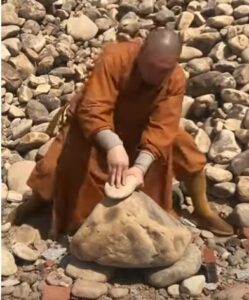
Examples of apparently superhuman strength exhibited by King Fu practitioners are common. These feats are possible because the practitioners have spent years training and developing their internal physiology just as an Olympic athlete would train their muscles and cardio for strength, speed and endurance. The video below demonstrates the incredible internal power than can be developed and released through the body. This isn't a demonstration of "strong fingers". In terms of modern science, you can think of the strike as transferring kinetic energy from the body into the rock through the fingers.
Intrigued? At Ling Shui we try to offer members to the opportunity to develop both the martial and the TCM aspects of Tai Chi as they prefer. Whilst we can't promise to have you smashing rocks with your fingers, we can teach you how to start developing these skills while also enjoying a nice hot cup of the finest green tea!
We have weekly classes in Penwortham, Bamber Bridge, Lostock Hall and Tarleton. Beginners are always welcome. For further details regarding times and locations, take a look on the classes page.
Click to watch a Shaolin Monk break rocks with nothing but his fingertips.
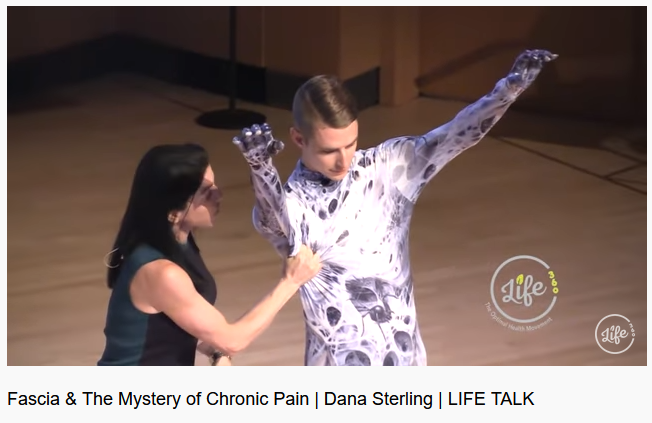
At Ling Shui we talk a great deal about the importance of the body's fascial layer in practising Tai Chi. It provides a useful bridge to understanding the apparent contradictions the two very different Western and Traditional Chinese medical paradigms.
From a Tai Chi perspective, we train ourselves to feel the physical connections within our body and use spiralling, coiling motions to move using those connections.
From a Traditional Chinese Medicine perspective, anyone who has used acupuncture to treat muscular pain will more than likely have been astounded at the relief that just a few small needles dotted around the body can have. The idea that the acupuncture channels are part of the fascia provides a possible explanation for the underlying physical processes that are at work.
The following video gives a wonderfully clear explanation of how the fascia plays a role in both movement and pain:
Traditional Chinese Medicine (TCM) is built around an entirely different paradigm to that of Western medicine. As a result, TCM can seem a little crazy when first encountered by Westerners who have only been exposed to the clinical approach to medicine . The void left by the lack of understanding is frequently filled with vague and confused language, often centred on the idea of energy. In fact, there's no need for mystical explanations. By understanding that the two medical traditions simply approach the human condition from different directions and that neither tradition is definitive, it's possible to find truth and value in both.
In recent years, Western science has increasingly investigated the claims of TCM with regard to treatments such as acupuncture and pursuits such as meditation, Tai Chi, Qigong and Yoga (which of course originates in India but is analogous to Tai Chi in many ways. That's the subject for a post all of it's own though!). The resulting studies are slowly building a picture of the real and tangible benefits to be gained from the Chinese model. The discovery of the Interstitium and investigation into facial layers within the body provide Western models with a medium through which the effects of treatments like acupuncture can be transmitted throughout the body.
Of course, those of us who practice Tai Chi and Qigong already know how beneficial it can be in helping to maintain physical and mental wellbeing, but it's always nice to have a little bit of Western science confirming what your body's telling you!
As Covid-19 continues to spread around the world, the following article discusses the benefits offered by Qigong and Tai Chi for people recovering from not only Covid, but other equally awful illnesses such as cancer...
When discussing our Tai Chi practice, there can be a tendency to rely on words such as Qi, Shen, Meridians and Dantian. Whilst these concepts are all important parts of Tai Chi, they can take time to understand and are open to widespread misinterpretation.
During our practice, we periodically practice the Zhan Zhuang standing meditation. This is a fundamental exercise in the practice of Tai Chi because it helps to cultivate Qi and Shen. But what does that actually mean?
Whatever else may or may not be happening when we practice Tai Chi, from a Western scientific point of view there are some very real, quantifiable physiological effects.
Click below to read a brief article published on the Yield Turn Push Tai Chi Blog which discusses what happens in the body during Zhan Zhuang practice and relates it to the concept of Qi...