
A BRIEF HISTORY OF CHEN FAMILY TAIJIQUAN
Chen Family Style is the oldest documented form of T'ai Chi Ch'uan. It gave rise to the four other traditional family styles Yang, Wu, Sun and Wu Hao and is characterised by slow movements alternating with fast explosive bursts, and by the silk reeling exercises unique to the style.

According to Chen Village family history, Chen Bu was a skilled martial artist who started the martial arts tradition within Chen Village. The Chen family were originally from Hong Dong in Shanxi. Chen Bu, considered to be the founder of the village, moved from Shanxi to Wen County in Henan Province in 1374. The new area was originally known as Chang Yang Cun or Sunshine village, which over time grew to include a large number of Chen descendants. Because of the three deep ravines (Gou) beside the village it came to be known as Chen Jia Gou or Chen Family creek/brook. For generations onwards, the Chen Village was never overrun by invaders or bandits and became known for their powerful family martial arts.
The unique techniques used in T'ai Chi Ch'uan practice are attributed to the ninth generation Chen Village leader Chen Wangting (1580–1660) who was the commander of the Wen County Garrison. He codified the Chen training practices into seven routines. This included five routines of t'ai chi ch'uan, 108 form Long Fist and a more rigorous routine known as Cannon Fist.
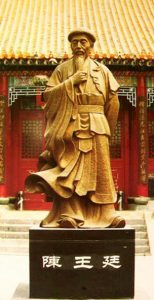
Chen Wangting also integrated different elements of Chinese philosophy into the martial arts training to create a new approach that we now recognize as the Internal martial arts. He added the principles of Yin-Yang theory (the universal principle of complementary opposites), the techniques of Daoyin (leading and guiding energy), Tui na (expelling and drawing energy), the Chinese medical theory of energy and Chinese medical theory of the meridians. Those theories encountered in Classical Chinese Medicine and described in such texts as the Huang Di Nei Jing (Yellow Emperor's Canon of Chinese Medicine). In addition, Wangting incorporated the boxing theories from sixteen different martial art styles as described in the classic text, Ji Xiao Xin Shu("New Book Recording Effective Techniques" ~ 1559–1561) written by the Ming General Qi Jiguang (1528–1588).
Chen Changxing (1771–1853), a 14th generation Chen Village martial artist, further distilled Chen Wangting's open fist training regime into two routines that came to be known as "Old Frame" (Lao Jia). Those two routines are named individually as the First Form (Yilu) and the Second Form (Erlu, more commonly known as the Pao Chui or "Three Emperor Canon Punch" in English). Chen Changxing, contrary to Chen family tradition, also took the first recorded non-family member as a disciple, Yang Luchan (1799–1871), who went on to popularize the art throughout China, but as his own family tradition known as Yang-style t'ai chi ch'uan. The Chen family system was only taught within the Chen village region until 1928.
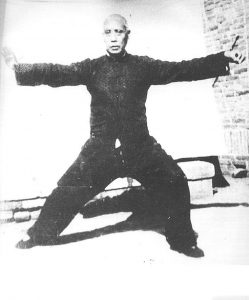
Chen Fake (1887-1957) developed the Old Frame Lao Jia routines making them faster and more explosive, with the martial intent of the movements being more overt. It was this New Frame (Xin Jia) which was taught to great acclaim in Beijing until the onset of the cultural revolution (1966-1976).
Today, Chen style T'ai Chi Ch'uan is championed by the "Three Lions" of Chen Jia Gou: Chen Zhenglei, Chen Xiaowang and Zhu Tiancai.
