

When I first began my Tai Chi journey 14 years ago, a phrase I heard repeated regularly was that to learn Tai Chi is to learn a new way of moving. Other concepts such as the Dantien, internal connections and the spiralling, circling nature of the movements were impressed on me again and again as I progressed in my training which, over time, began to make sense as I became increasingly aware of how my body felt during practice.
These concepts can seem a little esoteric for a new student more familiar with the ideas of Newtonian mechanics and cause and effect than with the Chinese concepts of Yin Yang, Qi and meridians. When introducing new students to Tai Chi I find it helpful to explain these ideas using concepts that are more familiar to the western mind such as potential/kinetic energy and elasticity.
In recent years, western medicine has increasingly begun to investigate and understand the role the fascia plays in the body. I'd like to suggest that it's the fascia which provides the internal connections we feel during practice and act as the medium through which forces/energy/Qi flows around the body.
If we balance on one leg, our body will make tiny internal adjustments to muscles and tendons in the supporting leg to help us balance. The body achieves this in part by means of proprioception, an unconscious process which happens automatically without the need for conscious engagement. As we progress in our practice, we aim to develop an ability to manipulate these subconscious processes in order to initiate and augment movement in the body without the usual recourse to the consciously controlled muscles we're all familiar with such as biceps, triceps, quadriceps or hamstrings. I find it helpful to think of the Chinese concept of shen as being, in part, this process of harnessing conscious control the tendons and muscles associated with the fascia in order to initiate movement and deliver additional power.
In my opinion, it isn't a great leap to imagine that the fascia and associated muscles and tendons are a significant physiological factor in the Tai Chi experience. The article below talks about the fascia, the role it plays in the body and it's importance to our muscle and bone health and will hopefully give you some food for thought when you next practice your forms...
Fascia: the most neglected part of our body is finally starting to receive attention
Adam Taylor, Lancaster University
We are constantly reminded about how exercise benefits our bone and muscle health or reduces fat. However, there is also a growing interest in one element of our anatomy that is often overlooked: our fascia.
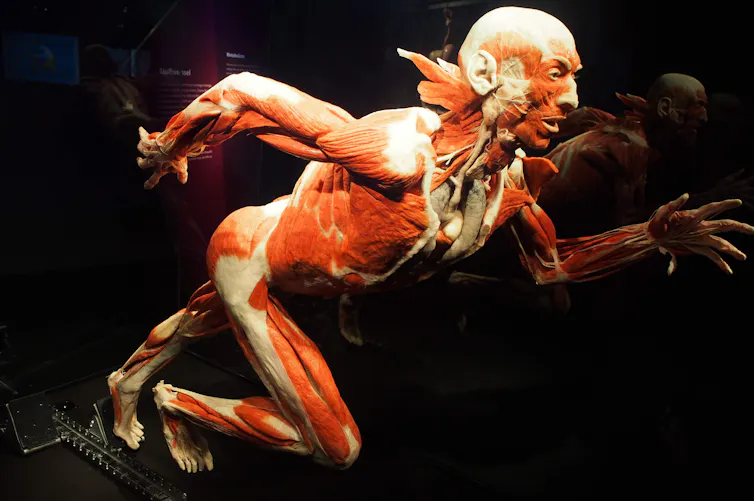
Fascia is a thin casing of connective tissue, mainly made of collagen – a rope-like structure that provides strength and protection to many areas of the body. It surrounds and holds every organ, blood vessel, bone, nerve fibre and muscle in place. And scientists increasingly recognise its importance in muscle and bone health.
It is hard to see fascia in the body, but you can get a sense of what it looks like if you look at a steak. It is the thin white streaks on the surface or between layers of the meat.
Fascia provides general and special functions in the body, and is arranged in several ways. The closest to the surface is the superficial fascia, which is underneath the skin between layers of fat. Then we have the deep fascia that covers the muscles, bones and blood vessels.
The link between fascia, muscle and bone health and function is reinforced by recent studies that show the important role fascia has in helping the muscles work, by assisting the contraction of the muscle cells to generate force and affecting muscle stiffness.
Each muscle is wrapped in fascia. These layers are important as they enable muscles that sit next to, or on top of, each other to move freely without affecting each other’s functions.
Fascia also assists in the transition of force through the musculoskeletal system. An example of this is our ankle, where the achilles tendon transfers force into the plantar fascia. This sees forces moving vertically down through the achilles and then transferred horizontally into the bottom of the foot - the plantar fascia – when moving.
Similar force transition is seen from muscles in the chest running down through to groups of muscles in the forearm. There are similar fascia connective chains through other areas of the body.
When fascia gets damaged
When fascia doesn’t function properly, such as after injury, the layers become less able to facilitate movement over each other or help transfer force. Injury to fascia takes a long time to repair, probably because it possesses similar cells to tendons (fibroblasts), and has a limited blood supply.
Recently, fascia, particularly the layers close to the surface, have been shown to have the second-highest number of nerves after the skin. The fascial linings of muscles have also been linked to pain from surgery to musculoskeletal injuries from sports, exercise and ageing. Up to 30% of people with musculoskeletal pain may have fascial involvement or fascia may be the cause.
A type of massage called fascial manipulation, developed by Italian physiotherapist Luigi Stecco in the 1980s, has been shown to improve the pain from patellar tendinopathy (pain in the tendon below the kneecap), both in the short and long term.
Fascial manipulation has also shown positive results in treating chronic shoulder pain.
One of the growing trends for helping with musculoskeletal injuries is Kinesio tape, which is often used in professional sports, although evidence for its effectiveness is mixed. It is also being used to complement the function of the fascia, and is used to treat chronic lower back pain where fascial involvement is a factor.

Real Sports Photos/Shutterstock
Fascia in disease
Aside from getting damaged, fascia can also provide paths that infections can travel along, within muscles.
The spaces between fascial layers are usually closed (think of cling film being folded over), but when an infection occurs, germs can spread between these layers. This is a particular problem in the neck, where there are several layers of fascia for infections to travel along.
In severe cases, surgery is often needed to remove the dead tissue and save the healthy remaining tissue.
One of the primary examples of fascia functioning in health, and the challenges its dysfunction can bring, is seen in the common complaint plantar fasciitis, which causes pain on around the heel and arch of the foot.
This incredibly common ailment affects 5-7% of people, rising to 22% in athletes. It is recognised as an overuse injury, causing the thickening of the fascial bands on the soles of the feet that help give the arch support.
Fascia can also be implicated in more serious health conditions, such as necrotising fasciitis. This is a rare but serious bacterial condition that can spread through the body quickly and cause death.
The condition is almost always caused by bacteria, specifically group A Streptococcus or Staphylococcus aureus. The initial infection comes from a cut or scratch, and then the bacteria travel along the fascia to other areas away from the initial site of access and multiply in the ideal environment afforded by the warm recesses of the body.
We can see it better now
One reason fascia has been overlooked in health and disease is because it was difficult to see using current imaging technology. More recently, though, MRI and ultrasound imaging have been shown to be beneficial in visualising fascia, particularly in musculoskeletal conditions such as plantar fasciitis, and pathological changes in the fascia of the shoulder and neck.
With the growing interest in fascia and the growing understanding of its contribution to musculoskeletal health, it’s sensible to suggest that we look after it in the same way we do with the rest of the musculoskeletal system - by using it. Simple techniques like foam rollers and stretching are beneficial in increasing mobility, but there is still much to learn about our fascia and the role it plays in our day-to-day health.
Clarification. The sentence: “One of the growing trends for helping with musculoskeletal injuries is Kinesio tape, which is often used in professional sports” has been amended to make it clear that evidence for the tape’s effectiveness is mixed.
Adam Taylor, Professor and Director of the Clinical Anatomy Learning Centre, Lancaster University
This article is republished from The Conversation under a Creative Commons license. Read the original article.
