2026 Seminar Programme

After a slow start to the year and to make up for missing the lunar new year, we've got a few seminars booked (with hopefully one or two more to follow before the end of the year).

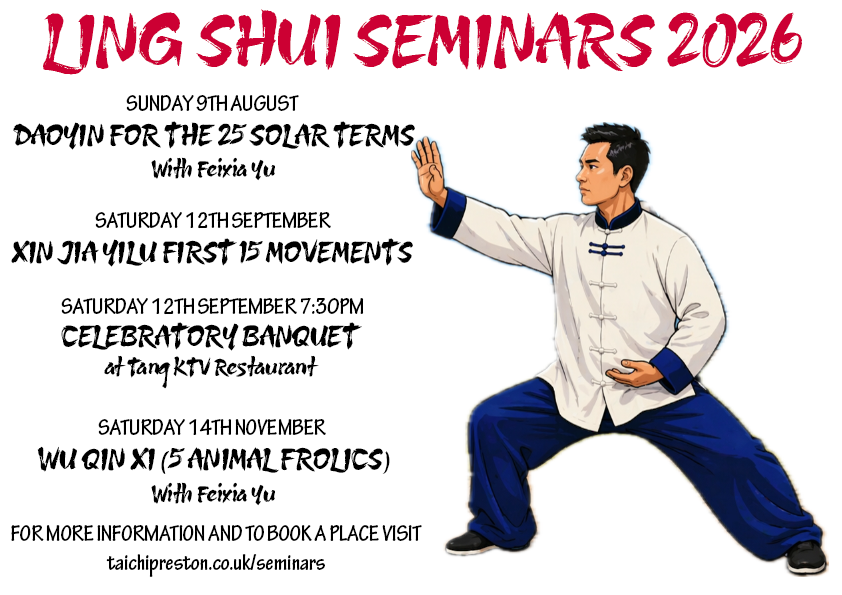
We've got Feixia Yu joining us in August and again in November, first for a TCM focussed dive into Daoyin for the 25 Solar Terms, followed by a refresher session looking at the Wu Qin Xi (5 Animal Frolics) sequence of exercises. Feixia's seminars are always popular so make sure you sign up as soon as possible to avoid disappointment.

In September we'll be running an afternoon workshop looking at the first 15 movements of Xin Jia Yilu. It's a  great opportunity for those familiar with the form to brush up their knowledge and the perfect introduction to the new frame for those only familiar with the old frame and Lao Jia Yilu. In the evening we'll be heading to Tang KTV Restaurant on Fylde Road in Preston for a club banquet. Tang is Preston's premier Chinese restaurant and our social gatherings there are always well attended. There's always a great selection of dishes shared on the table (including vegetarian), so whatever your tastes there'll be plenty of things to choose from. Club members past and present are welcome at the banquet (as are their plus ones) and attendance at the seminar earlier in the day isn't necessary.

For more information about the seminars, the workshop or the meal head over to the website where you can also book a place on your preferred event.

All our seminars are open to all none club members. The Qigong events require no previous experience or knowledge, however our Tai Chi seminars are not suitable for complete beginners. If you're unsure about whether to sign up, get in touch via our contact form.

Tai Chi and Parkinson's Disease

During an expedition down an internet wormhole I came across a BBC news article talking about the benefits of Tai Chi for sufferers of Parkinson's disease. The BBC article went on to show a couple of Yang Shi Ba Shi Qigong exercises labelled as Tai Chi. Anyone with more than a passing knowledge of the subject knows that Qigong exercises are not Tai Chi (although it could be said that Tai Chi is a subset of Qigong in so far as they both involve cultivation of internal energy). I'm petty enough to be irritated by this sort of inaccuracy, so I decided to dive a little deeper...

The article was based on a study first published by the Journal of Neurology, Neurosurgery & Psychiatry in October 2023. The paper was based on an average of 3.5 years' observation of groups practising Tai Chi twice a week for 60 minutes per session. The Tai Chi coaches were from a professional organisation called Sino Tai Chi who, after a little more digging online, I believe to be a Chen style Tai Chi organisation.

The study compared the persistent Tai Chi training group with a control group who didn't engage in any regular exercise beyond their usual daily activity.  Compared with the control group, the people who maintained Tai Chi training showed a slower annual worsening of overall Parkinson's symptoms. In addition, they required lower annual increases in the daily dosage of their medication, exhibited a delayed progression into further anti-Parkinsonian therapy and demonstrated greater stability and improvements in motor function tests such as balance and gait.

In addition, the Tai Chi participants showed a slower deterioration in cognitive function, autonomic symptoms, sleep quality and overall quality of life. They also exhibited a lower prevalence of motor and non-motor complications such as dyskinesia, cognitive impairment/dementia, drops in blood pressure and impulse control disorders.

The Tai Chi practitioners did report falls, dizziness and back pain, but these phenomena weren't significantly higher than those experienced by the control group.

In summary, the study suggests that persistent long-term Tai Chi training when delivered correctly is associated with slower symptom progression and improved functional outcomes in people with Parkinson's disease compared to people not engaged in regular training. Whilst it doesn't prove causation, it does provide compelling evidence that sustained physical training such as Tai Chi can be beneficial in long term management of Parkinson's disease.

Gōngxǐ Fācái 恭喜发财 - Happy New Year

Happy (Lunar) New Year!

2026 is the year of the Horse. We usually celebrate the New Year with a day of Tai Chi and Qigong practice followed by an evening out at our favourite Chinese restaurant, Tang KTV. Unfortunately, due to circumstances beyond our control, we're unable to hold our usual events and will be rescheduling them for later in the year. As we aren't celebrating physically, I thought it might be a nice idea to talk a little about how we can view the horse in terms of our Tai Chi.

The Chinese Year of the Horse reflects a symbolism that resonates deeply with both ancient philosophy and internal arts such as Tai Chi. Within the Chinese zodiac, each year is represented by an animal and the horse holds the seventh position in this repeating cycle. It's traditionally associated with strength, vitality, courage, loyalty, and freedom, all of which are qualities venerated in Chinese culture.

We can think of horse as representing movement and forward momentum. It doesn't hesitate, but rather commits fully. There's an old Chinese expression: "ma dao cheng gong", which translates roughly as “success arrives with the horse”, reflecting the idea of swift progress and decisive action. The idea of purposeful motion could be considered analogous to our Tai Chi practice. Although Tai Chi largely appears slow and gentle on the surface, beneath that calm exterior lies intent, direction, and continuity. Like the horse, our movement whilst practising Tai Chi never truly stops. Even in stillness, there is potential energy waiting to be released.

The horse can also be considered in terms of Yin - Yang theory. Yin and Yang describe the opposite and yet complementary forces which underpin all existence. Yin represents stillness, receptivity, and grounding, whilst Yang represents activity, expansion, and expression. The horse is unmistakably a Yang symbol embodying activity, warmth, and dynamic expression. Yet, like all Yang forces, it cannot exist without Yin. A horse at full gallop relies upon a momentary pause between each stride. Motion arises from stillness, and stillness prepares the way for motion.

This principle is at the very heart of Tai Chi. Every step emerges from rootedness. Every extension is supported by relaxation. Yin Yang theory tells us that movement and stillness are not opposites, but rather phases of the same cycle. The horse expresses this perfectly. It is powerful, but also sensitive. Responsive, yet grounded. Without balance, its strength would become instability.

In our Tai Chi practice we make direct references to the horse: The Horse Stance develops strength, stability, endurance, and structural integrity. It teaches patience and rooting, providing the foundation from which fluid movement can emerge. Without a stable base, motion loses its integrity. The horse teaches us that true freedom of movement comes from disciplined structure.

In Chen Tai Chi, the movement Part the Wild Horse’s Mane expresses calm control combined with a forward intention. The imagery is of gently separating a horse’s mane, not through force, but through sensitivity and guidance. One hand rises as the other settles, embodying the balance of Yin and Yang. Expansion and rooting occurring simultaneously. The body advances with quiet confidence, driven from the centre and expressed through relaxed, spiralling limbs. This movement teaches us that true power does not come from tension, but from coordinated, whole-body connection. Like approaching a spirited horse, it requires presence, steadiness, and respect. The practitioner learns to move forward without aggression, maintaining balance, structure, and inner calm. In this way, the movement reflects the deeper Tai Chi principle of strength guided by softness and motion governed by awareness.

In the spirit of the Horse, take a moment to reflect upon momentum in your own life. Set aside frantic activity in favour of purposeful direction. Even when the path is uncertain, continue to move forwards with courage and resilience. At the same time, Yin and Yang remind us that all progress should be balanced with stillness. Effort balanced with ease.

So you see, the horse is much more than just a symbol of speed. It's a reminder of harmony in motion. Strength guided by balance. Energy guided by awareness. And this, ultimately, is the essence of Tai Chi itself.


A Scientific Insight Into Fajin

When trying to explain the mechanics of Tai Chi can be challenging when you're unfamiliar with the Qi paradigm. We talk about energy releasing (fajin) in association with breathing, relaxation and intent, but what does it mean from the point of view of the Western biomechanical paradigm?

We came across this YouTube short from Professor Hannah Fry recently where she talks about using the breath to open jars. Whilst she isn't thinking about Tai Chi, Qi or even general martial arts theory, she is talking about the connection that the arms have to muscles located in the back and sides of our torsos and how the breath interacts with them. An awareness of these interactions makes it easier to feel them and in feeling, to harness them. If you find it difficult to make sense of some of these concepts, take a look below and see if she can give you a lightbulb moment!

Chen Ziqiang Warrington Seminars 2026

Happy (Gregorian) New Year!

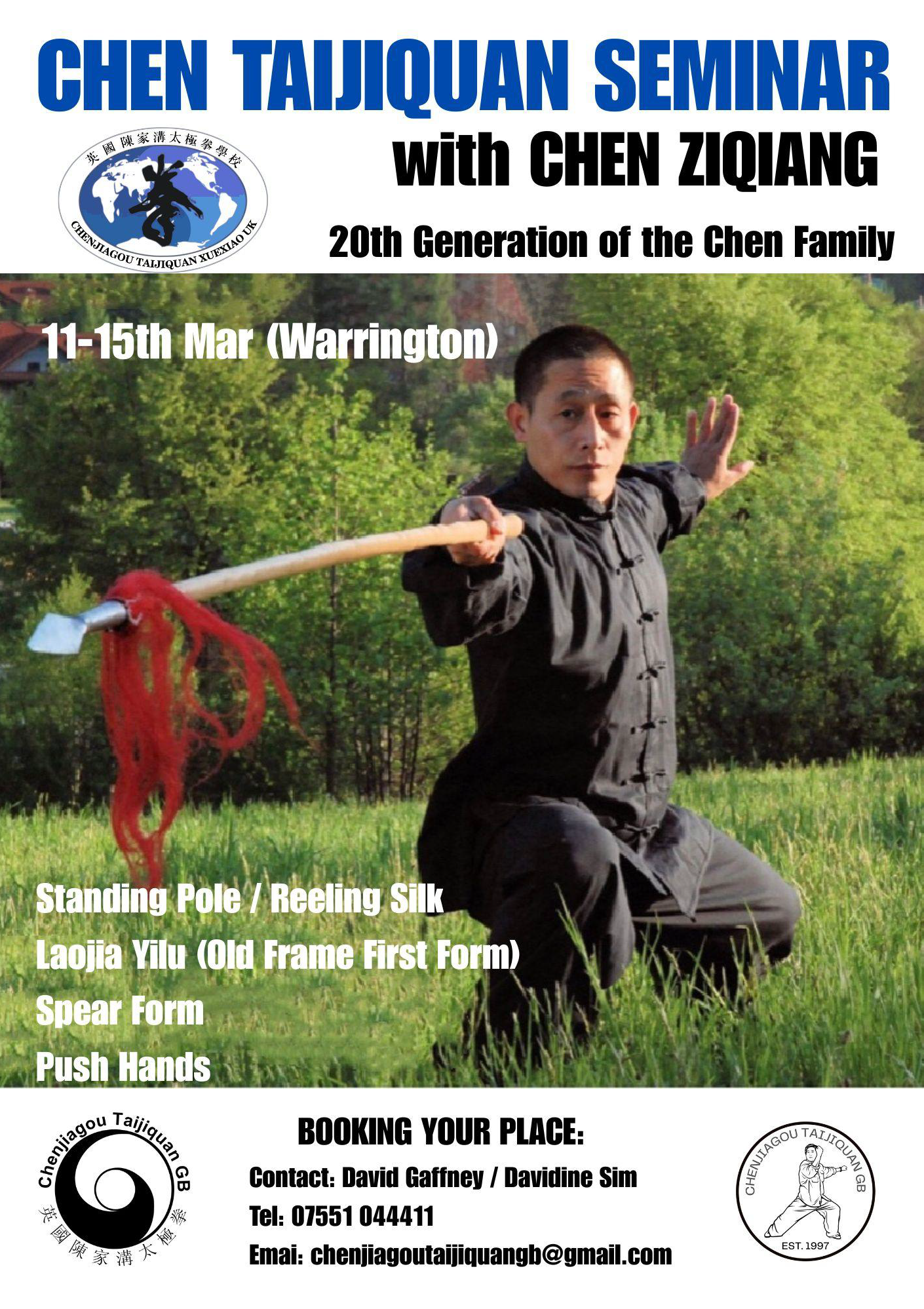
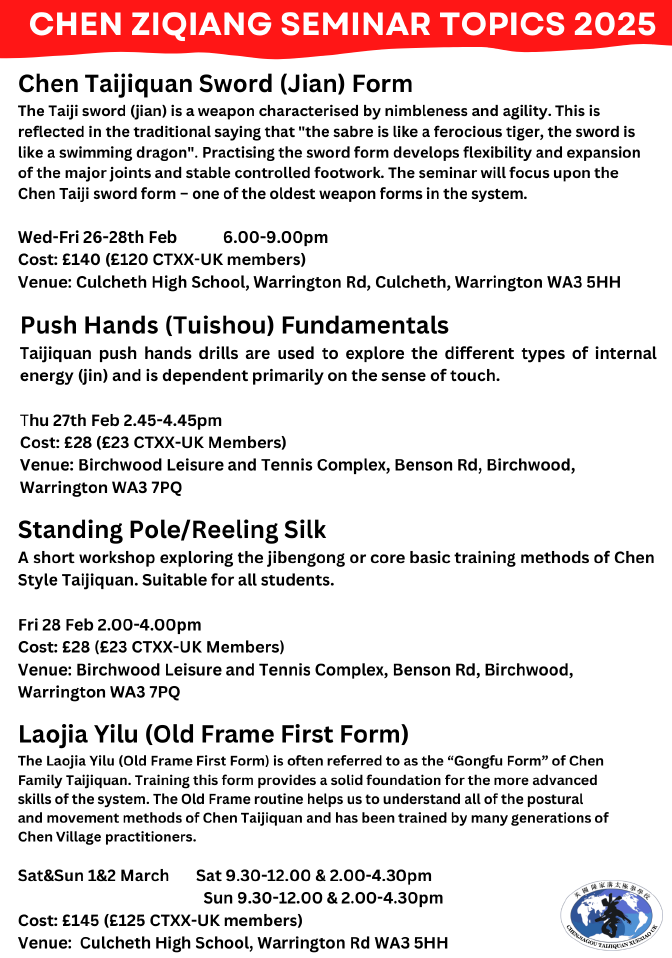
We've just received dates for Master Chen Ziqiang's annual Warrington seminars. This year in addition to his regular Lao Jia, Tui Shou and Standing Pole/Silk Reeling sessions he'll be looking at the Plum Blossom Spear Form which is great fun to learn.

Contact details for booking are on the poster below, or you can click here or on the poster to download a booking form.


Chen Ziqiang Warrington Seminars 2026
Chen Ziqiang Warrington Seminars 2026 - Click to download a booking form

Lao Jia Yilu Sections 1 & 2 with David Gaffney

Click flyer image to reserve a place

We're delighted to announce that we'll be welcoming David Gaffney, chief instructor at Chen Jiagou Taijiquan GB to spend an afternoon looking at the first two sections of Lao Jia Yilu.

David began his training in Asian martial arts in 1980, but has focused exclusively on Chen Taijiquan since 1996. He's trained with many leading Chen Taijiquan teachers and since 2003 has been training with Chen Xiaoxing in the Chenjiagou Taijiquan School.

His quest to experience the art in the most authentic way has seen him travel to China more than twenty times to train in Chen Jiagou, the birthplace of Taijiquan. He is one of the few westerners to be awarded an Advanced Instructor’s Certificate by the Chenjiagou Taijiquan School and holds a sixth Duan grade with the Chinese Wushu Association. He has published a number of books with Davidine Siaw-Voon Sim, including "Chen Taijiquan Illustrated" which we recommend to all students as a course handbook. David also publishes the popular Talking Chen Taijiquan blog.

David is one of the UK's leading instructors of Chen Tai Chi, so don't miss this chance to train with him in here in Preston. For more information regarding the forthcoming seminar, or to book a place, head over to our seminars page.

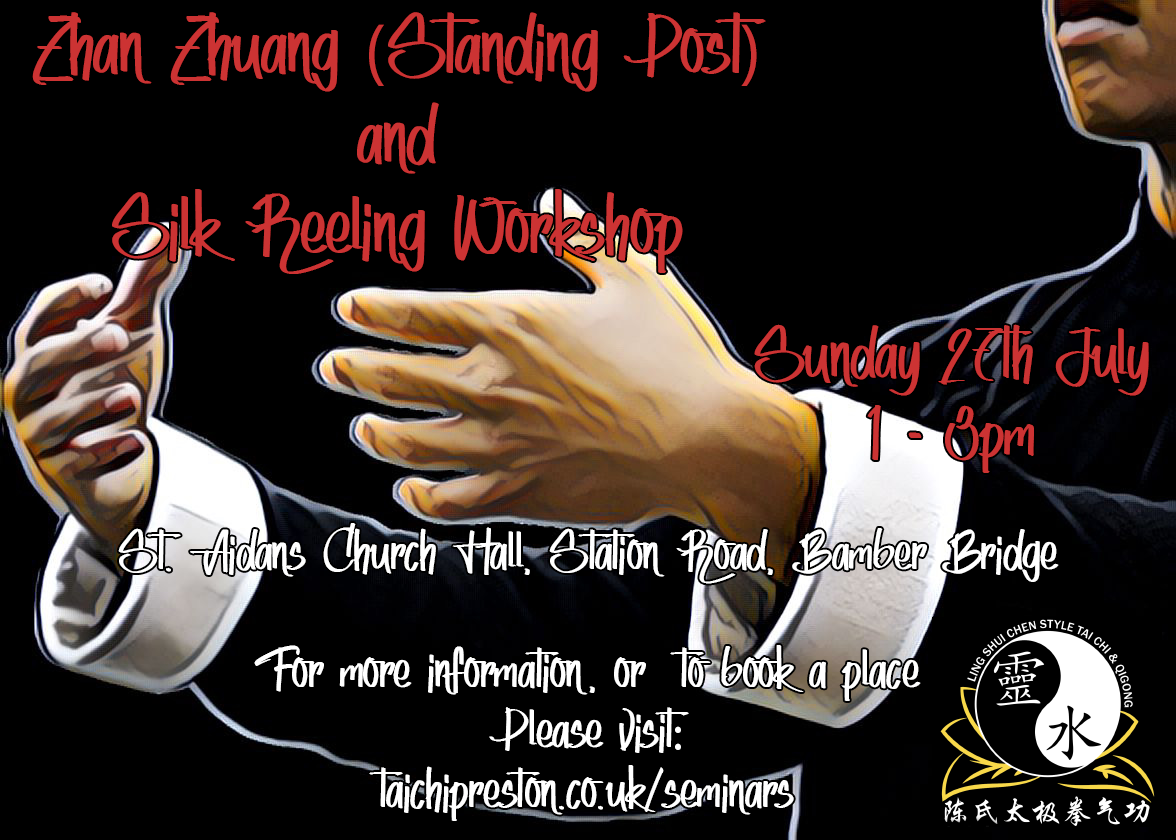
Zhan Zhuang & Chan Si Jin Workshop

Zhan Zhuang (Standing Post) is an iconic exercise practised across a spectrum of Chinese internal arts, while Chan Si Jin (Silk Reeling) is a foundational exercise of Chen Tai Chi. Both are intended to help train the body to sense, cultivate and feel Qi (internal energy) within the body.

We'll be holding a 2 hour workshop on Sunday 27th July at St. Aidan's Church Hall in Bamber Bridge where we'll be practising and improving both skills.


For further information or to book a place at the workshop, please visit our Seminar & Workshop Bookings page, or click the flyer below.


Improving Your Health With Tai Chi

In 2015 the British Journal of Sports Medicine published a study suggesting that Tai Chi is great for older adults with conditions like arthritis, COPD, and even heart issues. Researchers found it helps with pain, stiffness, and overall quality of life without making symptoms worse. The gentle, flowing movements combine relaxation with deep breathing, making it an accessible way to stay active. With evidence from over 30 studies, experts think Tai Chi could even be prescribed in the future for multiple chronic conditions.

Check out the BBC News Article here for more information and head to our classes page to find out when and where you can join us at a session and begin your Tai Chi journey.

Chen Ziqiang 2025 Seminars

It's the time of year when Master Chen Zhiqiang, Chief Coach of the Chenjiagou Taijiquan School and eldest son of Grandmaster Chen Xiaoxing, visits the UK to share his knowledge during a week of seminars looking at Push Hands, Straight Sword (Jian) Form, Lao Jia Yilu. Silk Reeling and Standing Pole (Zhan Zhuang)

To book a place on any or all of the seminars, Download the PDF here, or contact David Gaffney (details on the flyer below) to book yourself a place.


Happy Anniversary!

In September 2015 Ling Shui opened the doors on our Saturday morning Bamber Bridge class for the very first time. Since that humble beginning, we've moved location three times, weathered a global pandemic and openend up another five weekly classes in various locations.

In order to mark our first 10 years we'll be organising a number of events throughout the year, kicking off with the second instalment of our "Xin Jia First 15" seminar later this month. February sees our annual Chinese New Year celebrations to welcome in the year of the Snake with a full day of Tai Chi/Qigong, followed by a Chinese banquet in the evening. In September we'll be joined by guest instructor

Chen Taijiquan Illustrated by David Gaffney & Davidine Sim

David Gaffney for an afternoon seminar looking at Lao Jia Yilu. In addition to running The officially affiliated UK branch of the Chen Jiagou school, David is an accomplished author with several Tai Chi books to his name including "Chen Taijiquan Illustrated", which we recommend as a course handbook to all new students. We'll also be running our other usual Tai Chi and Qigong seminars throughout the year.

As if that wasn't enough, we'll be sending a delegation to take part in Master Chen Ziqiang's March seminar, Master Wang Hai Jun's residential double sabre seminar in April and Grand Master Chen Zhenglei's annual UK seminar in May. That's not to mention our various weekly classes in Penwortham, Bamber Bridge, Chorley, Lostock Hall and Tarleton.

While it's the quality of your practice that really matters, it doesn't hurt to look good while you're at it. To that end, we thought we'd milk the 10th anniversary concept for all it was worth and have put together some rather glamorous t-shirts and hoodies to set you apart from the hoi polloi. You'll find details and an order form here in our members area.

With so much happening this year, it's the perfect time to join us, so if you've been curious to find out more about Tai Chi there's no better time to take the plunge. Head over to our Beginners page and book your place now!