
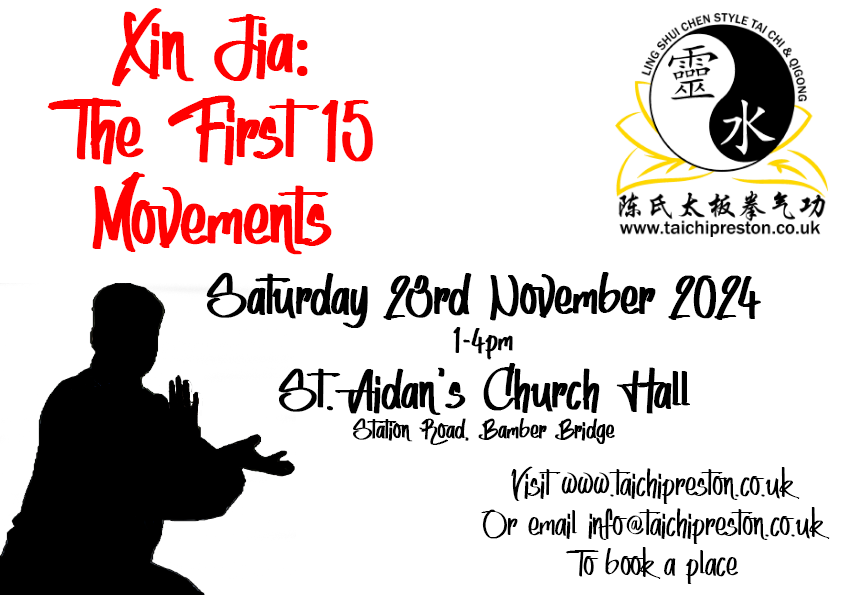
As Autumn draws in we thought it would be nice to squeeze one more seminar in before the end of the year so we've booked St. Aidan's Church Hall for the afternoon of Saturday November 23rd for a 3 hour refresher session looking at the first 15 movements of Xin Jia (or the 15 form as it's known to most club members). It will be a great opportunity to remind yourself of the sequence, improve your knowledge of the finer points of the form and practice moving from the centre. Head over to our seminar page to reserve yourself a place on the seminar.
Xin Jia Yilu, often referred to as the 83 Form or the "New Frame, First Routine," is a relatively modern development within Chen-style Tai Chi. The "New Frame" (Xin Jia) was created by Chen Fake (1887–1957), a 17th-generation master of the Chen family, who revolutionized the traditional Chen-style Tai Chi by refining and evolving the original forms. Xin Jia Yilu is the first routine of this New Frame and is seen as an adaptation and extension of the "Old Frame" (Lao Jia) created by earlier generations of the Chen family.
Origins of Xin Jia
The development of Xin Jia Yilu began during Chen Fake’s lifetime, particularly when he moved to Beijing in the early 20th century. Chen Fake was already highly respected for his mastery of Lao Jia, but his approach to the art evolved significantly during this period. As a response to the demands of the modern world and perhaps as a result of his deepening understanding of internal energy cultivation (neigong), Chen Fake began to introduce new elements to the traditional Chen-style form.
While Lao Jia is rooted in the teachings of Chen Wangting, the 9th-generation patriarch of Chen-style Tai Chi, who synthesized martial techniques with the Daoist principles of yin-yang and qi circulation, Chen Fake saw an opportunity to refine the movements. He introduced subtle but profound modifications to express greater complexity and sophistication. His changes led to the creation of two New Frame routines—Xin Jia Yilu (First Routine) and Xin Jia Er Lu (Second Routine)—with Yilu focusing on foundational techniques and Er Lu emphasizing explosive power (fajin).
At Ling Shui we practice our Tai Chi in the style of Master Wang Haijun. Here he is performing the first 15 movements of Xin Jia:
Differences Between Xin Jia and Lao Jia
While both Xin Jia and Lao Jia maintain the core principles of Chen-style Tai Chi, including circularity, spiralling energy (chan si jin), and the integration of softness and hardness, there are notable differences between the two. These differences reflect not only Chen Fake's innovations but also his deepening mastery of the art.
Spiralling Energy (Chan Si Jin): Both frames emphasize the concept of chan si jin, or "silk-reeling energy," which involves a continuous spiralling motion in the limbs and torso to generate power. However, Xin Jia places a greater emphasis on this principle, with more pronounced spiralling and twisting movements, allowing for finer control of internal energy.
Size and Complexity of Movements: Lao Jia tends to feature larger, more expansive movements that are relatively simple and fluid. In contrast, Xin Jia introduces more compact, intricate, and detailed movements. The smaller circles and increased complexity in Xin Jia challenge practitioners to control their internal energy (qi) more precisely and promote deeper coordination between the upper and lower body.
Fajin (Explosive Power): While both forms contain elements of fajin, the explosive release of energy, Xin Jia incorporates this principle more frequently and dramatically. In Lao Jia, fajin tends to be reserved for specific points in the form, whereas Xin Jia integrates fajin more seamlessly throughout, reflecting the increased intensity and internal power cultivated in this form.
Transitions and Flow: The transitions between movements in Xin Jia are more intricate and connected by internal energy flows, requiring practitioners to pay closer attention to the subtle connections between movements. Lao Jia emphasizes a smoother, more continuous flow, while Xin Jia often includes dynamic contrasts between soft and hard movements, reflecting a more complex understanding of yin-yang principles.
Internal Cultivation: Xin Jia focuses heavily on internal energy cultivation, emphasizing the role of the dantian (energy centre) in guiding movements. Practitioners of Xin Jia must maintain a heightened awareness of internal processes such as the movement of qi through the meridians, which in turn helps to inform the outward physical movements.
The Nature of Xin Jia Yilu
Xin Jia Yilu is a practice that demands a high level of internal awareness and energy management. While it's rooted in the same martial principles as Lao Jia, the New Frame goes beyond basic martial techniques and becomes a study of the internal workings of the body. Practitioners are encouraged to connect deeply with their internal energy, and movements must be executed with a level of precision that reflects this heightened awareness.
In the first routine, Xin Jia Yilu, practitioners focus on the fundamental movements that define Chen-style Tai Chi, but they are performed with a greater focus on internal dynamics and spiralling energy. This routine is an essential foundation for understanding the more advanced practices within Xin Jia, such as Er Lu, which focuses on fajin and combat applications. However, Yilu itself is considered both a comprehensive martial training and a meditative, health-promoting practice.
So there you have it! Xin Jia Yilu represents the continued evolution of Chen-style Tai Chi, a balance between tradition and innovation. While it maintains the core principles of the Chen family’s martial art, it also introduces new complexities and internal energy work that challenge practitioners at both a physical and mental level. This form showcases the richness of Chen Tai Chi, embodying centuries of wisdom while adapting to the modern practitioner's need for a deeper understanding of internal martial arts.
