Fascia: Where West meets East?

When I first began my Tai Chi journey 14 years ago, a phrase I heard repeated regularly was that to learn Tai Chi is to learn a new way of moving. Other concepts such as the Dantien, internal connections and the spiralling, circling nature of the movements were impressed on me again and again as I progressed in my training which, over time, began to make sense as I became increasingly aware of how my body felt during practice.

These concepts can seem a little esoteric for a new student more familiar with the ideas of Newtonian mechanics and cause and effect than with the Chinese concepts of Yin Yang, Qi and meridians. When introducing new students to Tai Chi I find it helpful to explain these ideas using concepts that are more familiar to the western mind such as potential/kinetic energy and elasticity.

In recent years, western medicine has increasingly begun to investigate and understand the role the fascia plays in the body. I'd like to suggest that it's the fascia which provides the internal connections we feel during practice and act as the medium through which forces/energy/Qi flows around the body.

If we balance on one leg, our body will make tiny internal adjustments to muscles and tendons in the supporting leg to help us balance. The body achieves this in part by means of proprioception, an unconscious process which happens automatically without the need for conscious engagement. As we progress in our practice, we aim to develop an ability to manipulate these subconscious processes in order to initiate and augment movement in the body without the usual recourse to the consciously controlled muscles we're all familiar with such as biceps, triceps, quadriceps or hamstrings. I find it helpful to think of the Chinese concept of shen as being, in part, this process of harnessing conscious control the tendons and muscles associated with the fascia in order to initiate movement and deliver additional power.

In my opinion, it isn't a great leap to imagine that the fascia and associated muscles and tendons are a significant physiological factor in the Tai Chi experience. The article below talks about the fascia, the role it plays in the body and it's importance to our muscle and bone health and will hopefully give you some food for thought when you next practice your forms...

Fascia: the most neglected part of our body is finally starting to receive attention
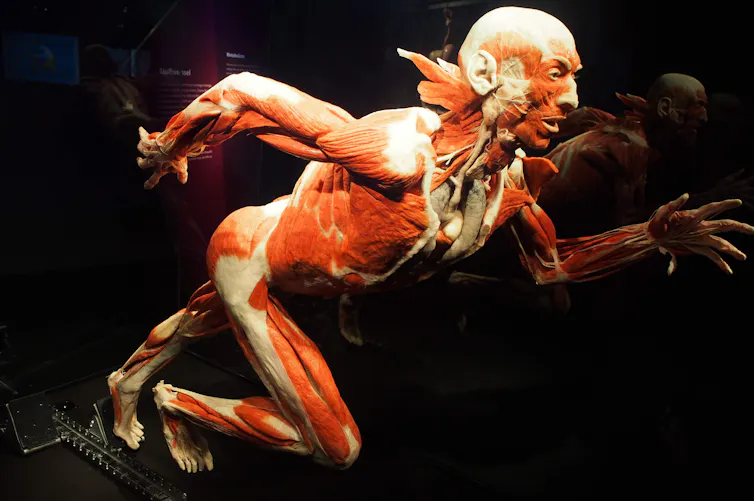
Photo Inspiration/Shutterstock

Adam Taylor, Lancaster University

We are constantly reminded about how exercise benefits our bone and muscle health or reduces fat. However, there is also a growing interest in one element of our anatomy that is often overlooked: our fascia.

Fascia is a thin casing of connective tissue, mainly made of collagen – a rope-like structure that provides strength and protection to many areas of the body. It surrounds and holds every organ, blood vessel, bone, nerve fibre and muscle in place. And scientists increasingly recognise its importance in muscle and bone health.

It is hard to see fascia in the body, but you can get a sense of what it looks like if you look at a steak. It is the thin white streaks on the surface or between layers of the meat.

Fascia provides general and special functions in the body, and is arranged in several ways. The closest to the surface is the superficial fascia, which is underneath the skin between layers of fat. Then we have the deep fascia that covers the muscles, bones and blood vessels.

The link between fascia, muscle and bone health and function is reinforced by recent studies that show the important role fascia has in helping the muscles work, by assisting the contraction of the muscle cells to generate force and affecting muscle stiffness.

Each muscle is wrapped in fascia. These layers are important as they enable muscles that sit next to, or on top of, each other to move freely without affecting each other’s functions.

Fascia also assists in the transition of force through the musculoskeletal system. An example of this is our ankle, where the achilles tendon transfers force into the plantar fascia. This sees forces moving vertically down through the achilles and then transferred horizontally into the bottom of the foot - the plantar fascia – when moving.

Similar force transition is seen from muscles in the chest running down through to groups of muscles in the forearm. There are similar fascia connective chains through other areas of the body.

When fascia gets damaged

When fascia doesn’t function properly, such as after injury, the layers become less able to facilitate movement over each other or help transfer force. Injury to fascia takes a long time to repair, probably because it possesses similar cells to tendons (fibroblasts), and has a limited blood supply.

Recently, fascia, particularly the layers close to the surface, have been shown to have the second-highest number of nerves after the skin. The fascial linings of muscles have also been linked to pain from surgery to musculoskeletal injuries from sports, exercise and ageing. Up to 30% of people with musculoskeletal pain may have fascial involvement or fascia may be the cause.

A type of massage called fascial manipulation, developed by Italian physiotherapist Luigi Stecco in the 1980s, has been shown to improve the pain from patellar tendinopathy (pain in the tendon below the kneecap), both in the short and long term.

Fascial manipulation has also shown positive results in treating chronic shoulder pain.

One of the growing trends for helping with musculoskeletal injuries is Kinesio tape, which is often used in professional sports, although evidence for its effectiveness is mixed. It is also being used to complement the function of the fascia, and is used to treat chronic lower back pain where fascial involvement is a factor.
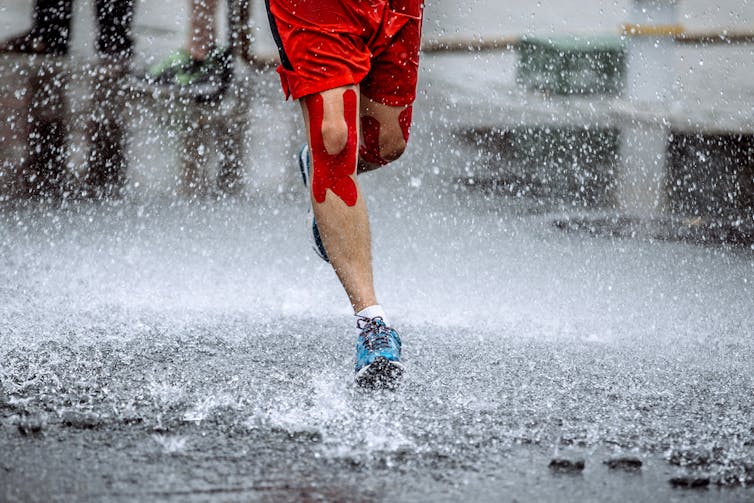
A runner with Kinesio tape on his legs.
Real Sports Photos/Shutterstock

Fascia in disease

Aside from getting damaged, fascia can also provide paths that infections can travel along, within muscles.

The spaces between fascial layers are usually closed (think of cling film being folded over), but when an infection occurs, germs can spread between these layers. This is a particular problem in the neck, where there are several layers of fascia for infections to travel along.

In severe cases, surgery is often needed to remove the dead tissue and save the healthy remaining tissue.

One of the primary examples of fascia functioning in health, and the challenges its dysfunction can bring, is seen in the common complaint plantar fasciitis, which causes pain on around the heel and arch of the foot.

This incredibly common ailment affects 5-7% of people, rising to 22% in athletes. It is recognised as an overuse injury, causing the thickening of the fascial bands on the soles of the feet that help give the arch support.

Fascia can also be implicated in more serious health conditions, such as necrotising fasciitis. This is a rare but serious bacterial condition that can spread through the body quickly and cause death.

The condition is almost always caused by bacteria, specifically group A Streptococcus or Staphylococcus aureus. The initial infection comes from a cut or scratch, and then the bacteria travel along the fascia to other areas away from the initial site of access and multiply in the ideal environment afforded by the warm recesses of the body.

We can see it better now

One reason fascia has been overlooked in health and disease is because it was difficult to see using current imaging technology. More recently, though, MRI and ultrasound imaging have been shown to be beneficial in visualising fascia, particularly in musculoskeletal conditions such as plantar fasciitis, and pathological changes in the fascia of the shoulder and neck.

With the growing interest in fascia and the growing understanding of its contribution to musculoskeletal health, it’s sensible to suggest that we look after it in the same way we do with the rest of the musculoskeletal system - by using it. Simple techniques like foam rollers and stretching are beneficial in increasing mobility, but there is still much to learn about our fascia and the role it plays in our day-to-day health.

Clarification. The sentence: “One of the growing trends for helping with musculoskeletal injuries is Kinesio tape, which is often used in professional sports” has been amended to make it clear that evidence for the tape’s effectiveness is mixed.

Adam Taylor, Professor and Director of the Clinical Anatomy Learning Centre, Lancaster University

This article is republished from The Conversation under a Creative Commons license. Read the original article.

The Five Most Important Taijiquan Skills for Beginners (Part 3)

Those of us who live in the North West of England are fortunate enough to have access to one of the world's finest exponents of Chen style Tai Chi in the area, Master Wang Hai Jun.

Master Wang has been All China National Taijiquan Champion in forms, weapons and push hands three times and is based in Manchester. In addition to his own achievements, he has also trained five other All China National Taijiquan Champions which is testament to the quality of his tuition. To find out more about Master Wang, you can visit his website here.

The following article, originally published in issue 36 of Tai Chi Chuan & Oriental Arts magazine, is the first of three outlining the five most important Tai Chi skills that a beginner needs to understand according to Master Wang, and was written by Nick Gudge, an Irish instructor and student of Master Wang.

The Five Most Important Taijiquan Skills for Beginners (Part 3 of 3)

In the first and second parts of this article, published in the Summer and Autumn 2010 editions of this magazine, I discussed what I consider to be the first three of the five most important taijiquan skills for beginners, namely fang song, peng jin and ding jin. In this article I discuss the fourth and fifth most important skills for beginners, Chen and Chan Si Jin.
Chen - Rooted

Chen has two meaning in Taijiquan. The first meaning relates to how the body must “sink” to connect to the ground. The second meaning relates to how the qi must be trained to always be sunk down. These two meanings refer to two separate but closely related skills.

The skill of “sinking” the body is dependent on the skill of fang song. The joints must remain loose but still coordinated together. The body is allowed to compress, either using the force of gravity or a force applied from another person. This compression must be directed by the body down the leg without causing stiffness.

Training the qi to remain sunk is more difficult to describe. The reference to qi is difficult for many people to understand and a direction to do something with qi brings even more difficulties. The dantian (or sea of qi) must move freely first. The qi moves naturally initially. Then, as the qi increases, it must be kept sunk and not allowed to rise out of control, e.g. getting excited or emotional. It must be sunk down to flood the legs and reach the ground. These actions can be felt clearly and unambiguously, in the body and legs, when the body and legs have been trained sufficiently and properly.

The combination of these two skills produces a skill that may appear unbelievable, where a significantly bigger and stronger person is unable to push over a smaller, weaker person; where someone on their back leg can simply push backwards someone opposing them on their front leg. However it is a basic skill which can be understood and developed with the correct teaching and considerable practice.

Through the skill of chen, incoming forces are directed down the legs to the ground and conversely outgoing forces are generally pushed from the ground. It requires a mobility in the hips and waist that is difficult to describe and comes from long and hard training in the correct manner. A student must be led to it by a teacher who not only understands the skill of it but also the skill of how to teach the skill. For strength to be connected to the ground it must first sink to the ground. In this respect chen is closely related to peng. Without a well developed peng jin, including a mobility of the dan tian a well developed chen or root will not be possible.

The outgoing force which pushes from the ground is not something mystical but the result of careful training, a coordination of peng jin, a certain type of leg and body strength and control. The body acts like a highly specialised and controlled spring. When it is compressed, the pressure goes to the ground and when it is released it pushes from the ground. A good root is essential to neutralize and release strength effectively using the internal method of Chen style taijiquan.

Understanding and developing a root is initially developed in standing (zhan zhuang) practice. Through correct standing practice peng jin and ding jin are developed along with balance and an understanding of qi. Training the body and qi to sink and remain sunk under pressure is a major focus of taiji forms. In the beginning moderated and slow movement allows the quickest route to understanding and increased skill. Closing the body during practice, the elbows to the knees and the shoulders to hips, helps develop the understanding of chen. Sinking at the start and end of each movement is part of the process of developing chen.

Practicing with longer and lower postures and relaxing the upper body and hips develops the leg strength that is fundamental to developing a strong root. More importantly, loosing the body (fang song), particularly the hips, so your qi naturally sinks to the legs and feet, helps develop a root. The intensity of practice and the strength required increases significantly as the qi sinks more to legs and a person’s root develops. After the skills of fang song, peng and ding are understood in the body and the mind, specific rooting exercises can be used to aid the development of chen.

When rooted under pressure, the feeling is that the joints redirect in a downward direction and the joint itself may move down slightly. It should not be mistaken for crouching down or simply bending the joints. To crouch down low usually provides improved mechanical leverage and requires greater leg strength. The mistake of lowering the body is frequently mistaken for sinking. A lower stance will strengthen the legs but not necessarily develop the root. Initially the skill of chen is trained in a more upright position as it takes more skill to be lower and be rooted than to be more upright and rooted.

Chan Si Jin - Silk Reeling Skill

The type of motion required in taijiquan is called silk reeling or chan si. Although I list it as the fifth most important skill for beginners to pay close attention to, without chan si jin there can be no taijiquan. Chan si describes how the body must move to move the qi, to maintain peng jin and to co-ordinate the constant opening (kai) and closing (he) of the outside and inside of the body that taiji is composed of.

Again it is not easy to describe or to understand in its entirety because it needs to be understood more by the body than by the mind. For the body to understand, it needs to be able to approximate chan si motion repetitively until its entirety is grasped. This is done through the continuous and repetitive practice initially of reeling silk exercises (chan si gong) and then, more importantly, forms (tao lu.)

For the beginner chan si gong can be considered the early training of taiji shen fa (body mechanics) in movement. By following the relatively simple choreography, in a progression from simple to more difficult, (first with one hand and then with both hands, first stationary then with steps,) the beginner will find how the body moves in circles and spirals. For the beginner the internal movement is not important. Paying attention to winding in (shun chan) and winding out (ni chan,) front circle (zheng mian) and side circle (ce mian), and normal direction (zheng) and reverse direction (fan) is sufficient. Try to move smoothly and without stiffness. Gain the skill of fang song by removing the blockages caused by stiffness in the joints. Aim to get all parts of the body to move in a circle and spiral.

This form of spiral movement not only appears on the surface of the skin, but also appears inside through the whole body. It causes every joint and limb to experience motion. Through repeated coiling and stretching in the training for a prolonged period of time, the body will naturally attain the resilient and elastic strength (peng jin – discussed in part 2) that is loose and yet strong at the same time. Chan si jin is the method that the body uses to move so as to retain peng jin.

In the mid 1980’s teachers from Chen Village, notably Chen Xiao Wang and Chen Zheng Lei, as well as others created silk reeling exercises (chan si gong.) These exercises were derived from important movements in the training forms to aid in the development of chan si jin. It became well established quickly as a means of teaching larger groups the basic grasp of movement in Chen style taijiquan, particularly helpful for those without regular access to direction and correction from a good teacher and whose practice time is too short to allow progress in understanding to be made immediately through the traditional forms. Although these sets of exercise may look different from teacher to teacher, they all train the same set of principles.

(For those interested there is a DVD of the reeling silk exercises I recommend for beginners on my website (www.wanghaijun.com) There is also a longer article which provides a beginner’s commentary on training in reeling silk exercises with me.)

In summary, over these three articles I have described the five most important skills at the foundation of taijiquan for beginners. My hope is that those who wish to understand and gain the skills of taiji will be aided by these descriptions. In Chen Style we say there are three requirements needed to gain gongfu. A good teacher, good understand and good practice. History has shown that all who have achieved a high level of skill had all three. These articles aim to help in understanding what taiji is and what its skills are. Gongfu may be translated as skill, but the idea of time spent is a more useful translation.

In Chen Style Taiji the yilu (first form) is the foundation route taken by all those who have reached the third level. While the erlu, weapons forms and push hands form an integral part of the training, too often students reach for these before the basic skills which they utilize are established. Without developing the basic skills of fang song, peng jin, ding jin, chen, & chan si jin, progress will be limited.

In my own training with my teacher Chen Zheng Lei, these ideas were not explained to me in a theoretical way, but arrived at after long practice with regular correction and derived from experience. These were not ideas we first discussed but principles that grew out of my practice and the repeated correction from my teacher. It is important that the student understand this and not neglect their practice. In the beginning, training taijiquan is like paddling upstream: as soon as you stop paddling you will move backwards. So train steadily and without a break with a good teacher and progress will come to you.

The Five Most Important Taijiquan Skills for Beginners (Part 2)

Those of us who live in the North West of England are fortunate enough to have access to one of the world's finest exponents of Chen style Tai Chi in the area, Master Wang Hai Jun.

Master Wang has been All China National Taijiquan Champion in forms, weapons and push hands three times and is based in Manchester. In addition to his own achievements, he has also trained five other All China National Taijiquan Champions which is testament to the quality of his tuition. To find out more about Master Wang, you can visit his website here.

The following article, originally published in issue 35 of Tai Chi Chuan & Oriental Arts magazine, is the first of three outlining the five most important Tai Chi skills that a beginner needs to understand according to Master Wang, and was written by Nick Gudge, an Irish instructor and student of Master Wang.

The Five Most Important Taijiquan Skills for Beginners (Part 2 of 3)


In the first part of this article, published in the Summer 2010 edition, I discussed the first of the five most important taijiquan skills for beginners, fang song. In this article I discuss what I consider to be the second and third most important skills for beginners, peng jin and ding jin.
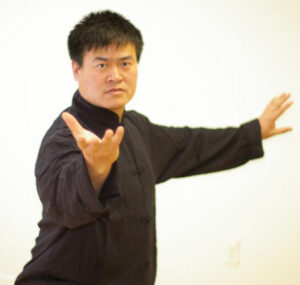
It is worth repeating that these are difficult ideas to formulate in words. They are difficult to gain an understanding of. It is difficult to grasp the skill of them. They must be shown. The student must be led to them. They are not skills that lead themselves to be grasped intuitively. This is why most people do not get a good basic grounding in them. Many teachers do not have these skill, so naturally it is not possible for their students to gain them. Even today, after more than 20 years of high level taijiquan practitioners being available as visiting teachers, still the level of these skills is not as high as it might be given the dedication, perseverance and effort of many players here in the UK.


2. Peng Jin - – an outward supportive strength: the basic skill of taijiquan

Peng Jin (sometimes simply Peng) is the core skill of taijiquan. All other taijiquan skills are based around the skill. It comes from loosening the body (fang song) and stretching. In essence, ‘stretching but not straightening’ the joints. Peng is not a natural or instinctive skill. It comes from a long period of correct practice. Without a good understanding of peng and then considerable training to transform this understanding into this skill in every part of the body, it will not arise. Peng will not be gained by accident. It is systematically trained into the body over time.

When I was exploring writing this piece I considered making peng jin the first most important skill of taijiquan. However, while peng should be considered the most important skill, it is dependent on loosening the body (fang song.) It is an effective argument that Taijiquan is peng jin chuan because without peng there is no taijiquan. It is taijiquan’s essential skill. Peng is always used when moving, neutralizing, striking, coiling etc,. Through peng all other taijiquan skills are utilized.

The phrase peng jin has been the source of some confusion. The two characters (peng and jin) have several meanings in Chinese and specific meaning within the context of taijiquan. Jin is itself is not simple to translate into English. There is no one effective word that can be used. It is translated variously as skill, strength and energy and the term incorporates all of these meanings. Peng is even more difficult to translate. It has been frequently translated as “ward off energy”. I prefer the phrase ‘outward supportive strength’ as a translation.

Chen Fake taught that there are two types of peng jin. The first is the fundamental skill or strength of taijiquan. The second is one of the eight commonly recognized taijiquan jins, (peng, lu, ji, an, cai, lieh, zhou & kao.) The first type of peng is the core element that is the foundation of these eight commonly recognized skills. It is perhaps best considered in English as a separate term from the peng that is listed as one of these eight skills. All eight jins have their basis in peng that is the fundamental skill. From the outside peng has different appearances so it is sometimes called the eight gates (after the eight directions,) but the heart of all eight is always peng the fundamental skill. It is this fundamental skill or strength that I am referring to when I talk about beginners skills. In the past ten years there has been much talk about peng. A student cannot simply demonstrate and use peng just because they will it. It requires external posture training combined with internal jin training to be able to correctly express it. If you do not have peng then you do not have Taijiquan’s jin and it follows that you also will not have lu, ji or an etc”.

The fundamental skill peng describes when the limbs and body stretch or extend while maintaining looseness or fang song. Without looseness (fang song) the body is stiff and peng is lost. If the body is too loose or limp then peng is also lost. Without stretching the body is not properly connected and peng is lost. If the limbs and body are over extended then they become rigid and peng is lost. So it is fairly easy to see that a “balance” must be maintained to retain peng. If any part of the body does not have peng, it is an error and must be remedied appropriately. Many form corrections are about regaining peng to various parts of the body, most commonly the knees and elbows. Typically peng is lost or lessened because the body has stiffened or not been loosened sufficiently, most commonly the hips and shoulders.

For those who do not comprehend peng, it can be barely discerned in the surface of the forms. For those who do comprehend peng, its absence is clearly visible. In many respects the basic hand forms of taijiquan specifically works as a peng jin training arena.

Peng jin is not an “on / off” skill. While it is easy not to have it, once it is understood its quality can be improved. Like any form of understanding e.g. learning a new language, it is quite possible not to understand anything in the beginning. While learning there are many degrees of improvement or quality that can be sought and reached. From this understanding it is quite easy to see not only the importance of looseness (fang song) as an integral pre-requisite for peng – this fundamental skill of taijiquan – but also, that improving the appropriate looseness of the body will improve the quality or degree of peng skill.

It is very difficult to convey the idea of peng jin without hands on correction. The student needs to be lead to it after an initial degree of looseness is gained. It is not a “Step One leading to Step Two” type process. Rather it is a process of immersion which leads to understanding. Hands on, frequent correction of the body is required. Understanding the concept generally, will not necessarily translate to a compete understanding in the body. It is a process. Wandering off can and does happen frequently. As an old Chen village saying says, what is required is a good teacher, good understanding and good practice. Without all three gong fu will not be attained. It requires a teacher who understands and can see where the priority of correction is required to enable a student to understand the idea of peng in their body and not to become distracted or confused.

From inside the body, when peng is present any pressure is transferred to the ground (rooted.) The stretching process connects the body in such a way that this happens without additional effort. It could be called a flexible structure inside the body. Consequently when peng is present the body becomes a little like a solid rubber object. It is not rigid, but loose and flexible where pressure to any part is easily transferred across its whole structure.

When touching someone else peng can been described as an audible skill because, not only does it allow the detection of fine motions of an opponent (as if through the sense of hearing,) it also allows determination of their structural weaknesses. When touching a person with peng it become possible to know the best direction to attack them as well as being able to comprehend what the other person is doing and even intending to do. Listening skill (ting jin) occurs through peng jin.

In taijiquan the emphasis of peng is on leading and neutralizing of an incoming force. When peng jin is present there is the potential for rotation. With loose joints the body becomes mobile and by stretching it becomes connected. So any pressure on the body causes rotation or motion. Peng is at the heart of silk reeling as we will see in the last article of this series.

It is also the skill which allows and supports attack. It allows for a rapid response for rapid attack and a slow response for slow offensive. In push hands (tui shou) practice, the student is said to have crossed the threshold only when they have learned the meaning and skill of peng jin. Beginners often take years to accomplish this. While practicing, not only the hands and arms but where any part of the body that comes into contact with the other person a taiji player should make use of this outward supportive or warding force.

So, using peng, a skilled practitioner not only can detect what an opponent is doing, they can neutralize it, detect the direction of vulnerability and attack through it. When this understanding is reached it is easy to see why it is considered the core skill of taijiquan. Where the joints are not loose, peng is lost. Where the limbs are limp and not stretched peng is lost. So beginning with loosening the body, then adding stretching without becoming rigid, the skill that is peng jin becomes manifest in the body. Initially at the start and end of each posture, then continuously in the process of motion.


3. Ding - Upright and Straight

The meaning and understanding of ding is not difficult to grasp, thought the practice of it takes much more time. Ding means upright or straight and ding jin means upwards pressing skill, strength or power.

When beginning to learn taijiquan, loosening the body includes loosening the spine. If the body is not held upright then there will be excess muscular activity leading to stiffness. Most people do not know what it is to stand up straight. They have the habit of locking their knees, causing a tilt in the pelvis, which in turn causes their body to leans backwards. This creates significant stiffness around the spine and across the lower and mid-torso and hips.

When the body is upright (ding) then it becomes possible to loosen the spine and the waist and then the hips. If ding is not present then it is most likely none of these can be achieved. When the student understands and maintains ding and consistently stretches without stiffening to produce peng in their body and movements, then the circulation of qi will become evident to them. As with all things in taijiquan, this is a process, with consistent and lengthy practice producing results.

More importantly this upward stretching without stiffening has the effect of lifting excess stresses off the various parts of the spine and allowing them to move freely, similar to the way traction in hospital can free the back from inappropriate strains and pressures so it can move freely. One additional result is that the circulation to the head through the neck is improved. Consequently the movement of qi around the body becomes more noticeable.

There is a famous taijiquan saying xu ling ding jin, (which can literally be translated as ‘empty leading upward energy’.) Its most common English meaning is "the crown / top of the head is pulled upward as if suspended by a string.” Chen Xin's explanation uses the image of a string pulling upward the bai hui acupuncture point (at the rear of the crown of the head.) When the head is as if suspended or raised upward, the resulting position of the head enable it to turn freely and aids the balance of the body.

So to summarise, ding can be considered the principle that dictates stretching the spine upward to understand and maintain balance, reduce stiffness and to understand and increase both peng and fang song. This basic skill is frequently first grasped in standing exercises like zhan zhuang. The lack of motion allows the student to focus more easily on gaining the correct balance and looseness in the body.

The third and final part of this article, looking at the fourth and fifth most important two skills for beginners, (chen and chan su jin,) will be available in the next edition of the magazine.

The Five Most Important Taijiquan Skills for Beginners (Part 1)

Those of us who live in the North West of England are fortunate enough to have access to one of the world's finest exponents of Chen style Tai Chi in the area, Master Wang Hai Jun.

Master Wang has been All China National Taijiquan Champion in forms, weapons and push hands three times and is based in Manchester. In addition to his own achievements, he has also trained five other All China National Taijiquan Champions which is testament to the quality of his tuition. To find out more about Master Wang, you can visit his website here.

The following article, originally published in issue 34 of Tai Chi Chuan & Oriental Arts magazine, is the first of three outlining the five most important Tai Chi skills that a beginner needs to understand according to Master Wang, and was written by Nick Gudge, an Irish instructor and student of Master Wang.


The Five Most Important Taijiquan Skills for Beginners (Part 1 of 3)

Many people spend years studying taijiquan but for most of them their progress is slow in gaining the skills of taijiquan. Part of this is probably insufficient practice, but a significant element is not understanding the basic skills that beginners are required to develop. It is not possible to start taijiquan training and learning at a high level. Using conventional learning as an analogy, it would be like trying to start at Phd. research level. In reality, first there is primary education, then secondary education, then undergraduate study etc. This is equally true in taijiquan. Without a good mental and physical understanding of the basic skills that are at the foundation of taiji, high level taiji skills will not be developed. It is not magic, but the result of consistent and sufficient training in the correct manner.

When asked what I consider the five most important skills for a beginner student in taijiquan, I listed them as:

1. Fang Song – Loosen the body by relaxing the joints

2. Peng Jin – an outward supportive strength, the basic skill of taiji

3. Ding Jin – upright and straight

4. Chen - rooted

5. Chan Si Jin – Reeling Silk Skill

These five basic skills should be considered the early steps in taijiquan training. Without these basic skills being embedded in the body and the accompanying changes that occur during the process, a student is stuck outside of taijiquan. They are learnt through exercises and in the process of learning and training the foundation form of taijiquan.

All of these ideas are very difficult to describe in words. In a recent article in the Spring 2010 edition of this magazine I wrote about the traditional Six Stages of Learning in Chen style taijiquan. At the request of my students, in this three part article I have provided some understanding of what to concentrate on as a beginner to make progress in Taijiquan,. This article introduces these ideas and examines more closely the first of them. The second article covers the second and third skills and the final article covers the fourth and fifth skills and summarises.

These beginners’ skills are complimentary to each other and are acquired slowly with persistence of practice. Understanding what they are does not come all at once. With the aid of a teacher, the mind grasps a bit of the idea first. Then, with considerable practice, the body gets the idea. Then with lots more practice it becomes a part of a person. It is not like a light switch, being either on or off, although some part of learning these skills can seem that way. Only when the body understands at a certain level can the mind grasp what is beyond that level. As many teachers have commented, it is not possible to jump to a full understanding. It is not a mental trick, or something to do with intellect or high intelligence. It is a process that has many possible detours and no short cuts.

These five basic skills are not learned one after the other. The student does not completely understand fang song before starting to understand peng jin. Rather they are collective, with progress in each skill acting as an aid to progress in the others. A little bit more skill gained here and a little bit more there. Persistence in practice provides the opportunity for progress. The more practice done utilising these skills the more progress is made.

I thought at first to put Peng Jin as the first skill as it is the central taijiquan skill. However, without fang song, peng jin will not develop, so I will start by talking about fang song.

Fang Song – Loosen the body

The first of these skills is fang song, sometimes abbreviated to song. Song is frequently translated as “relax.” While this is true, it does not really describe the process. The joints must relax, but as a consequence other parts of the body must work hard, particularly the legs. Loosening the joints is perhaps a better translation. The result should not be a body like a cooked bowl of noodles: rather it should be like a solid piece of rubber, strong but not stiff. The term fang has two meanings. The first is about something remaining under control, connected to both the mind and the body (i.e in this case not going limp.). The second is to put something down, away from you. The combination of these two meanings provides the understanding needed.

For most people studying taijiquan, song appears early on in their lessons. Unfortunately, most adults (and many children) are much stiffer than they realise. We do not know where we are tight, nor the degree of stiffness we generally maintain in our joints. In taijiquan, song describes the requirement of loosening the joints, relaxing the habitual stiffness from them, getting used to holding them without stiffness, then moving them without stiffness: Shoulders and hips, elbows and knees, the spine, particularly in the waist, the ankles and wrists.

When a joint is loosened, it is free to rotate or turn without hindrance or resistance. It is this ability that is required in taijiquan. The taijiquan classics talk of even the smallest pressure of a feather or a fly causing movement, like a finely balanced and oiled ball-bearing, where even the lightest touch causes it to rotate.

How do we know when a joint is stiff? Well, initially we do not know it is stiff, but as a learning tool it is probably more effective to say that as adults they always are stiff, usually to a much greater degree than we realise. While this is an unpalatable truth, it is a good starting point. A good teacher helps a student see where their stiffness lies. The student needs to be shown repeatedly where a joint is stiff. This is because the student neither knows that the stiffness is there nor how to loosen it. Their habit is to move with this stiffness. With practise, the joints become looser, and deeper structural stiffness becomes apparent. As the shoulders loosen, the arms feel heavier. As the hips loosen, the legs work considerably harder. So, for the beginner, heaviness in the arms and the legs working very hard, are good indicators that the skill of fang song is being developed.

Stiffness is difficult to recognise, but the effects of stiffness are easier to see. As the joints stiffen, they rise up. As they are loosened, the body, particularly the hips and shoulders, sinks down. For a beginner it is easy to confuse bending the knees for relaxing the hips (song kua), and lowering the arms for relaxing the shoulders. One of the many reasons why taijiquan is called an oral art is that it requires a teacher who understands to show the way. Most people need to be shown the way repeatedly before they understand it in their mind, and then corrected repeatedly before they understand it in their body. Much practice through this process is required for it to make sense and take hold. Many people get the basic idea in their mind but do not practice enough to realise it in their body.

There is a method or order to progression. The forms of taijiquan are the framework on which the method is hung. Within the forms, each posture offers an opportunity to understand the various levels of loosening the body.

Around each joint is a structure of muscle. For all the joints that rotate, we can initially consider them having a top, bottom, front and back. Each part needs to be trained to loosen before the joint will open properly. As an example, let us look at fang song in the hips. (This process is called song kua – loosen the hips.) In the hips, usually the stiffness in the top section is most prominent. Once this is loosened then the front becomes more prominent and can be paid attention to. After this, attention can be paid to the back of the hip and then the underneath part. The student needs to be shown where to relax many times until they catch the idea, then practice until the loosening takes place in the body without need of attention. Once this skill is gained in one part, then the mind can be used to address the next area of stiffness. Each student is a little different but the process is the same.

As each part of a joint is loosened, other parts of the body assume the workload of holding the body. In the beginning, this is mostly felt in the legs. Loosening the hips a little brings a significant additional workload onto the thighs. Until the legs become used to doing this extra work, no more loosening of the hips can be learnt. Loosening the hips a little makes the legs work much harder. Practicing with this extra work in the legs makes them stronger. When they have been strengthened in this way and are used to this extra work, then more loosening can take place. There is a saying, to gain taiji gong fu, go to bed with tired legs and wake up with tired legs. In other words, loosen the hips so the legs work so hard that even in the morning they are still tired.

Once the joints are loosened, they will be free to rotate properly and to transmit rotation to and from other parts of the body. This is a fundamental requirement of taijiquan. Any impediment to the joints rotating freely will result in a diminishing of taijiquan skill. The more joints that are unable to rotate freely, or the greater the resistance within each joint, the less taijiquan skill will be apparent. The more joints that are able to rotate freely, or the lesser the resistance within each joint, the greater the taijiquan skill will be apparent. This is why loosening the body is the first, most basic skill in taijiquan.

The second article will focus on helping beginners grasp the ideas of peng jin and ding jin.

HAPPY NEW YEAR!

New Year, new you?

If you're one of those people who have been intrigued by videos of Chinese parks filled with people gracefully practising Tai Chi, what better time to find out more, take the plunge and come on down to a session?

All our classes resume on Thursday 4th February (find all times and locations here) and beginners are always welcome. Just head to our Beginners Page to book yourself a place.

The video below is actually from Central Park in New York rather than somewhere in China, but it gives you a good idea of the Chen style Tai Chi we learn and practice...


Free Chinese Opera Workshop at UCLan

UCLan's Confucius Institute is hosting a free workshop about the Chinese Opera tomorrow, Thursday 9th October. There's no need to register, just turn up!

The workshop will look at Opera and the Chinese Performing Arts of Water Sleeves, Mask Changing and the Classical Chinese Ribbon Dance

Time: 2-3pm on Thursday 9th of November.

Venue: Foyer of Student Centre, University Square, UCLan, Preston, PR1 7DP


Chen Zhenglei returns to the UK!

Grand Master Chen Zhenglei will be visiting the UK again in late November/Early December for a number of seminars. He'll be visiting Manchester from Friday 1st December until Sunday 3rd December for another 3 day seminar, this time focussing on Laojia Yilu corrections and Tui Shou (push hands) training.

May's seminar was hugely popular and offered a wonderful opportunity to learn from one of Chen Tai Chi's four tigers! For more information or to reserve a place, click the image below.

Click to book a place at Grand Master Chen Zhenglei's December 2023 Seminar

Autumn Qigong Seminar News

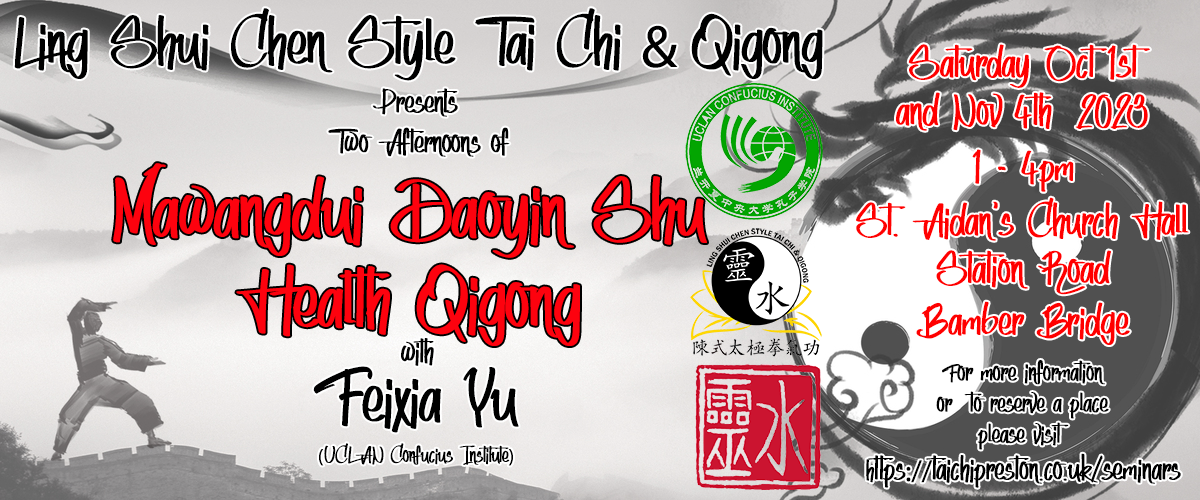
I don't know how many years you have to do something before it becomes tradition, but we'll once again be joined for an Autumn seminar by the wonderful Feixia Yu. Last year's popular seminar gave an overview of the 12 exercises which make up the Mawangdui Daoyin 12 Movements, some of which we've subsequently worked on in our Qigong classes over the last 12 months. This year we thought we'd revisit the set, but wanted to allow more time to look at each individual exercise. As a result we've decided to split the seminar into two 3 hour sessions: Saturday 21st October and Saturday 4th November, each running from 1 - 4pm.

In addition to her work as Director of UCLan's Confucius Institute, Feixia also hosts her own regular online Qigong classes. This summer she travelled to Tokyo to take part in the 10th World Health Qigong Tournament and Exchange where she won two silver medals, one for the Ba Duan Jin and the other for Liu Zi Jue (Six Healing Sounds). Over 500 athletes from almost 30 countries competed, including a number of very accomplished practitioners from the well respected Shanghai Sport University.

You'll find full details about our Mawangdui seminar and book a place via our seminars page. If you'd like to know a little more regarding the history of the exercises you might like to read this news post about last year's seminar.

Click to visit our Seminars page

As if all that wasn't enough, the UCLan Confucius Institute has organised an event to celebrate the Chinese Moon Festival this coming Saturday 30th September. Guests are invited to come along and try a variety of moon cakes and green teas. The celebration is taking place at Caritas Care Plungington Community Centre, Brook Street, Preston PR1 7NB next Saturday 30th September from 2:30 - 3:30pm. To book yourself a place, click here.


World Qigong Day!

Did you know that it's World Qigong Day this coming Saturday, 9th September?

We're fortunate enough to have the opportunity to practice every Saturday morning (see our classes page), but for those not able to join us, The UCLan Confucius Institute will host a World Health Qigong Day Wellbeing celebration on the University Square from 1:00 to 2:30pm.

The event is free of charge, but booking is required in order to take part. The workshop will be lead by Ms. Feixia Yu, Director of the UCLan Confucius Institute and a regular guest instructor at Ling Shui seminars. A double silver medallist at this year's 10th World Health Qigong Tournament in Tokyo, Feixia is not only an accomplished practitioner but also a wonderful teacher and this is a great opportunity to practice with her in the heart of Preston.

The workshop will be of low to medium intensity, combining gentle stretches with deep breathing and is suitable for all levels of fitness. The event will also be broadcast on Zoom for those who would love to join in but can't be there in person.

To take part via Zoom:

Meeting link: https://us02web.zoom.us/j/81261394172?pwd=UUJRbnVzb1QvR0xYZDlRN043Yy9DQT09

Meeting ID: 812 6139 4172

Passcode: UCLan-2023

Click the image below to book your place:

New Frame 15 Form (the first 15 movements of Xinjia)

Although as a club we focus on the old frame of Chen Tai Chi, we include the new frame 15 form in our syllabus to help students better appreciate the connections between Dantian and arms/hands. The form is derived from the first 15 movements of Xinjia Yilu, but online examples of the variation we practice are as rare as the proverbial rocking horse dung. The video below features the incomparable Grandmaster Wang Haijun performing the 15 form in the manner we practice it.

Grandmaster Wang is based just outside Manchester and for the last couple of years I've been lucky enough to spend a couple of hours a week training with him. Training with him has helped me to better understand the importance of good posture and to feel the internal connections within my body. This  in turn has changed my approach to teaching, which I hope is trickling down to the broader membership of the club. For those who are unfamiliar with the Grandmaster, here's a little bit about him from his website:

"Grandmaster Wang Haijun was born in January, 1972 in Zhengzhou city in Henan province. At the age of nine his father arranged for him to move to Chen Village to live and study with Grandmaster Chen Zhenglei. Each day before school he would train from five to seven thirty in the morning. After school he would train from four until six, frequently training again in the evening for another two hours before going to bed.

In the autumn of 1988, he gained entry to the Wuhan Physical Culture University, one of the top universities of its kind in China. He competed successfully for his university in many competitions. After graduation Grandmaster Wang Haijun was assigned to the post of coach of Pingdingshan Wushu Research and Study College. He is a senior state Wushu referee, the president and head coach of Zhengzhou Wushu Research and Study College, and coach of Henan Chen Zhenglei Taiji Culture Co., Ltd. He is an official lineage holder of Chen Style Taiji (12th generation Chen Taiji).

He has an extensive list of accomplishments in competition. In 1992 he won three gold medals in national competition, and won the championship in push-hands at the National Taiji Boxing, Sword and Push-hands Competition. In 1994 he won two gold medals in Taiji boxing and sword at the International Wenxian Taiji Championships, and he won the 80-kilo championship in push-hands at the National Wushu Championships. For three consecutive years, 1996, 1997 and 1998, Grandmaster Wang won gold medals in form, sword and push hands as well as the all-around champion’s gold medal at the Chinese National Championships – the highest level of competition in China.

Since 1990, Grandmaster Wang has been taking his students to top level competitions in Henan province and the Chinese National Championships. His expertise as a teacher is demonstrated by the fact that his students have won more than 30 gold medals at these competitions. Students of his that have won gold medals at the Chinese National Championships include: Fu Nenbin (push hands, 56 kg class), Fu Zihui (push hands, 52 kg class), Yang Lei (push hands, 65 kg class), Zhao Zhifang (push hands, 63 kg class), and Shi Zhenwen (push hands, 52 kg class). Grandmaster Wang has been certified as 7th Duan in the Chinese National Wushu Association Duan Wei System."

So, that's the man... here's the video:

Grandmaster Wang Haijun demonstrating the New Frame 15 Form