
A BRIEF HISTORY OF QIGONG
Qigong (pronounced chee-gung) is also written qi gong, chi kung, or chi gung. Regardless of how it’s spelt, in the immortal words of Tom Jones, it's not unusual for the uninitiated to confuse it with Tai Chi.
Whilst Tai Chi could be considered a form of Qigong, it is ultimately a martial art with real world fighting applications. Tai Chi consists of a series of movements with underlying martial intent. These movements, when learned and practiced without the martial intent, have been found to deliver a myriad of health benefits.
In contrast, Qigong involves discrete exercises (or sets of exercises) which incorporate posture, movement, breathing and meditation to promote physical and spiritual strength and wellbeing.
Wikipedia defines Qigong as:
"...a millennia-old system of coordinated body-posture and movement, breathing, and meditation used for the purposes of health, spirituality, and martial-arts training. With roots in Chinese medicine, philosophy, and martial arts."
Historically, what we today call Qigong was referred to as Daoyin which can be translated as "leading and guiding the energy". The term Qigong only came into general usage in the 20th Century.
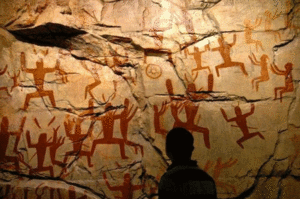
Chinese rock and pottery art dating back as far as 3000 BCE depict animals in motion and people with animal attributes (such as a human head on the body of a fish). This suggests that the ancient Chinese were able to depict movement and had an interest in expressing abstract ideas through art. The earliest known Qigong-like movements were ritualistic animal like dances performed by ancient Chinese Shaman.
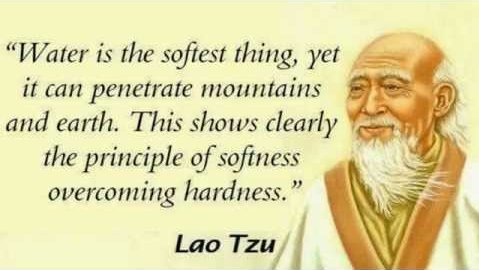
The concept of Qi, or vital energy was first documented in 1122 BCE in the "I Ching" or "Book of Changes" which explored the relationship between the three powers of Heaven, Earth and Man. Almost 700 years later, around 450 BCE, Lao Tzu, the founder of Daoism, described how the breath should be collected and allowed to descend in the body in his book "Dao De Jing". The Dao De Jing, along with the concepts of the Five Elements or Phases, and Yin and Yang formed the roots of Chinese Medicine which echo through history to the modern day.
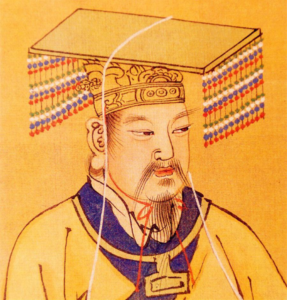
By 300 BCE, China was in what is now considered as a golden age. Scholars such as Lao Tzu and mythical figures such as The Yellow Emperor, Huang Di (2698-2598 BCE) were largely venerated . Huang Di is generally attributed as being the originator of many of the health and longevity practices associated with Qigong and it was at this time that his thoughts and ideas were published in "The Yellow Emporer's Classic of Internal Medicine" which is still considered the definitive reference for what we today call Traditional Chinese Medicine (TCM).
Over the ensuing centuries, Buddhism and yoga meditation techniques, which had been practised in India for thousands of years, came to China and were gradually integrated into the Daoist internal theories and practices.
These concepts, largely the domain of religion, were taught only to the initiated. Maintained as closely guarded secrets, they were not shared with laymen.
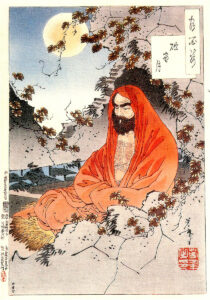
Around 500 BCE a Buddhist Monk, Bodhidharma, travelled to China from Central Asia/India and introduced Chan Buddhism to the Chinese. According to legend, Bodhidharma visited with Monks at the Shaolin Temple in Deng Feng county, where he became known as Da Mo.
It is Da Mo who is credited with unifying the spiritual and martial aspects of Qigong, teaching the monks how to improve their health and martial abilities through internal and spiritual practices, thus giving rise to Shaolin Kung Fu. Amongst his teachings was the Yi Jin Jing (meaning Muscle/Tendon Change), which is still practised today. the Yi Jin Jing is a set of Qigong exercises designed to enhance physical health and strength when practised regularly. The techniques that Da Mo taught to the Shaolin Monks were so effective that they were kept secret to avoid their enemies learning and using those same techniques against them. Gradually, as the ideas circulated throughout China , this secrecy meant that many variations of the routine developed. At the same time, the combining of spiritual and TCM principles gave rise to many different styles of Qigong such as Ba Duan Jin (8 Pieces of Brocade), Wu Qin Xi (5 Animal Frolics) and Liu Zi Jue (6 Healing Sounds).

For the next 1400 years, Qigong continued to evolve and develop. Many physicians were also Qigong Masters and Chinese medicine incorporated Qigong as a core treatment in conjunction with, amongst other things. acupuncture and herbalism.
With the advent of the Cultural Revolution in 1966, Qigong and TCM were devalued and seen as archaic Daoist practices. Viewed as none scientific, they became taboo. The communists purged TCM practitioners from schools and hospitals, with many practitioners being imprisoned and even killed. Whilst the
communists introduced Western medical science in China, the absence of centuries old medical practices inevitably lead to health problems across the population. This health crisis lead to a change in attitude from the Chinese Communist party who, after the Cultural revolution, repealed the ban and allowed TCM and by extension Qigong, to be practised once more. In 1979 the National Association for Chinese Medicine was founded and many TCM texts were republished.
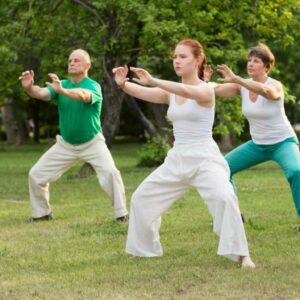
Since then, Qigong has flourished globally. The discovery in Western science of the interstitium and ongoing research into the fascial layers has provided a bridge between the two very different paradigms of Western and Chinese medicine.
As we discover more and more about the positive physical and mental effects of Qigong, it's popularity continues to grow. At Ling Shui our practice encompasses both the more physical and traditional forms plus more modern, gentler exercises aimed primarily at helping the elderly and infirm.
